AI Agent Guides Needle in Mouse Brain Surgery Experiment
· GlobeWire Daily Editorial Desk · Source: www.indiatoday.in
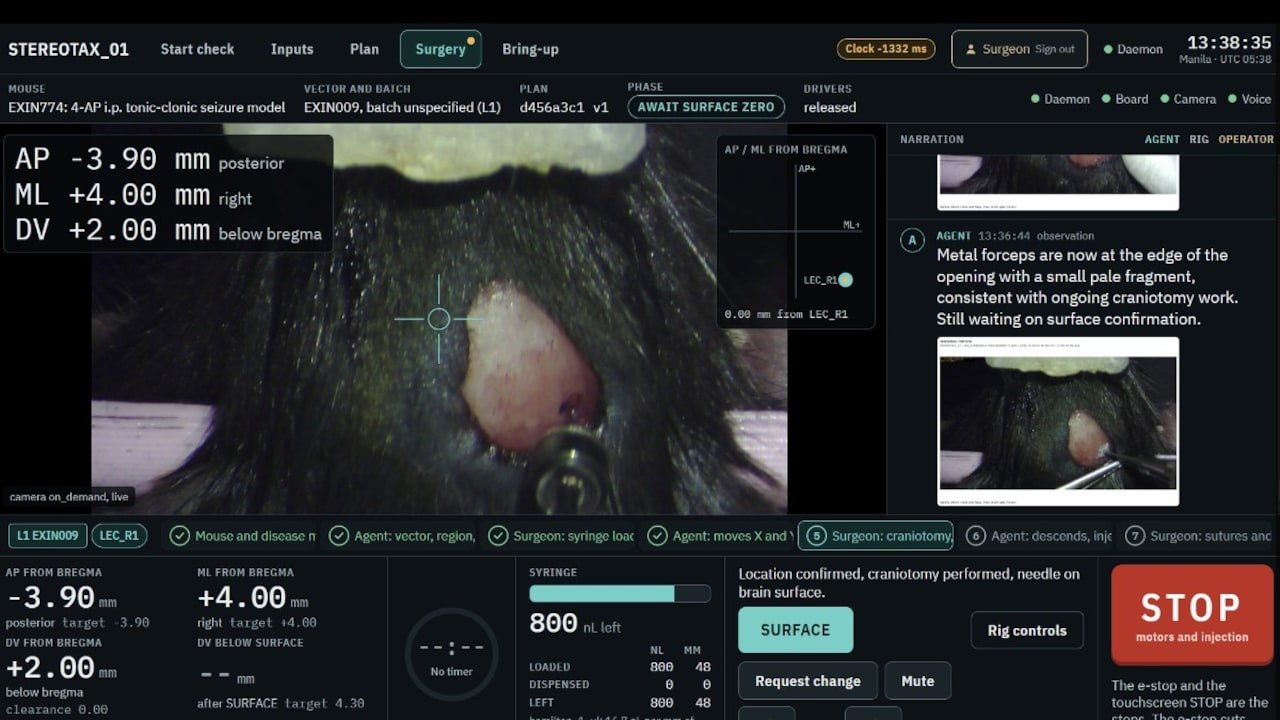
Image: India Today · Photo source · Resized and letterboxed to 16:9; no AI generation
Artificial intelligence has taken a step into medical research following a reported experiment where an AI agent selected a treatment, identified a brain region, and operated a robotic machine to inject a gene therapy vector into a mouse with epilepsy.
According to a social media post by Gabriel Ocana-Santero, co-founder of biotechnology startup Exin Therapeutics, researchers provided the AI agent with 19 gene therapy options and a single objective: to reduce seizures in a mouse model of epilepsy.
How the Procedure Unfolded
The reported experiment involved several distinct stages combining artificial intelligence and human supervision:
- Treatment Selection: The AI analyzed the provided data and selected a gene therapy treatment intended to increase a chemical signal that calms excessive brain activity.
- Location Determination: Drawing information from three scientific research papers, the AI identified the target brain region for the injection.
- Robotic Operation: The AI drove a motorized stereotaxic rig, guiding a needle into the brain to inject 250 nanolitres of the treatment while monitoring the site through a camera.
Safety Controls and Human Oversight
The procedure was not fully autonomous. A human surgeon handled the initial skull opening and final wound closure. Additionally, a licensed veterinarian approved critical irreversible steps and held a physical emergency kill switch to stop the AI agent if necessary.
During the procedure, the AI reportedly refused to move the needle when it detected incorrect equipment positioning, declining a researcher's request to try again. The team later identified a machine calibration issue, indicating the AI may have flagged a genuine safety risk.
Practical Implications and Verification
While the researcher reported that the mouse recovered well, it remains unconfirmed whether the treatment actually reduced epileptic seizures. This experiment serves as an early-stage demonstration rather than an approved medical procedure.
Readers should note that this account is based on a public post by the researcher and requires independent scientific peer review and verification. Future developments can be tracked by looking for peer-reviewed studies from the researchers or independent laboratories working on automated laboratory procedures.
AI-assisted reporting; source claims are attributed and have not been independently verified.
More to read
 AI Agent Performs Brain Injection on a Live Mouse – What It Means for Lab Automation
 New Tool Transforms Technical Books into On-Demand Agent Skills
 TencentDB Agent Memory Introduces Team-Level Hub for AI Workflows
 Orca Project Emerges as an AI Agent Orchestrator for Multi-Model Workflows
Related coverage
Related reporting available at publication.
AI Agent Performs Brain Injection on a Live Mouse – What It Means for Lab AutomationNew Tool Transforms Technical Books into On-Demand Agent SkillsTencentDB Agent Memory Introduces Team-Level Hub for AI WorkflowsOrca Project Emerges as an AI Agent Orchestrator for Multi-Model Workflows Amazon Warns Engineers That Relying Solely on AI Does Not Guarantee Productivity
 Amazon Expands AI Shopping Assistant Features for Lists, Registries, and Deliveries