Claude Opus 5.5 Skill Turns Code Into Short Videos – How “video‑director” Works
· GlobeWire Daily Editorial Desk · Source: github.com
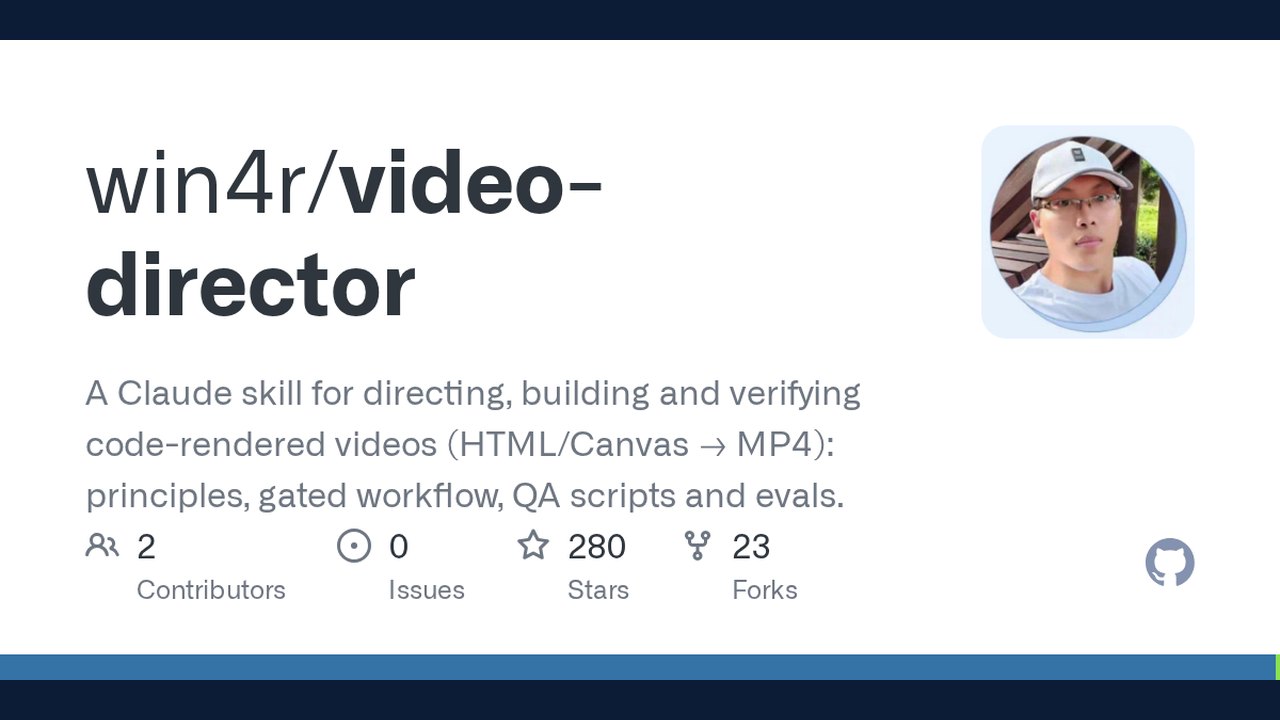
Image: GitHub · Photo source · Resized and letterboxed to 16:9; no AI generation
What the skill does
"video‑director" is a Claude Code skill that lets the Claude Opus 5.5 model act as both director and coding agent. Given a plain‑language brief, the skill guides the model through:
- Planning the short film in numeric terms (duration, frame‑rate, resolution).
- Generating deterministic animation code – HTML / Canvas, SVG, Three.js, GSAP or Remotion – that can be rendered frame‑by‑frame.
- Rendering the code to an MP4 file using external tools (ffmpeg, Node + Playwright, Chromium, etc.).
- Quality‑checking the output with two built‑in QA scripts and a final revision loop.
The result can be a launch teaser, a data‑driven explainer, a looping social‑media reel, or any short‑form visual story.
Core principles
- Deterministic build – the same brief always produces the same code, making debugging easier.
- No shot library – the skill does not ship pre‑made video assets; everything is generated from code.
- Gate‑based workflow – each phase (plan → code → render → QA) has an explicit checkpoint that must pass before moving on.
Typical setup
| Requirement | Details |
|---|---|
| Claude model | Claude Opus 5.5 selected in Claude Code |
| Runtime | Python 3 with `numpy` & `Pillow`; `ffmpeg`/`ffprobe` for encoding |
| Rendering | Node.js with Playwright + Chromium or Remotion |
| Optional | `faster‑whisper` for automated narration checks |
To install, copy the `video-director/` folder into your personal Claude Code skills directory (or zip it and upload via the Claude apps).
Example prompts
- “Make a 15‑second looping launch video for our CLI. Everything you need is in the README.”
- “I need a ~30‑second narrated explainer on how a bloom filter works, 16:9.”
- “Create a 20‑second Reel from `subscribers.csv` for our public account. Keep it honest.”
The skill also accepts feedback on existing coded videos, e.g., “the text is unreadable” or “the pacing feels slow”, and runs the QA scripts to suggest fixes.
Reported evaluation
The repository includes a small internal evaluation:
- Round 1 identified basic craft issues (missing opening frame, low‑contrast text) and two content gaps (late tagline, missing phrase “false positive”).
- Round 2 added rules that forced a hook and call‑to‑action within the first three seconds, ensured on‑screen terms match spoken narration, and prevented labels from covering counting numbers.
- The tests were single‑run per configuration, so they illustrate direction rather than statistically robust performance.
- No controlled comparison with other LLMs was performed; the authors note that other capable coding agents could follow the same workflow.
Practical implications
- Developers can prototype short videos without learning a graphics stack; the skill writes the code for them.
- Content teams gain a deterministic pipeline that can be version‑controlled like any source code.
- Verification is built‑in: the QA scripts flag measurable defects (frame size, audio level, contrast) before the final MP4 is delivered.
How to verify the claim
- Clone the GitHub repo: `https://github.com/win4r/video-director`
- Follow the installation steps and run the provided `run_skill.sh` example with a simple brief.
- Inspect the generated MP4 and compare it against the QA script output (`qa_check.py`).
- Optionally, modify the prompt or the gating rules to see how the workflow reacts.
Limitations & unknowns
- The skill relies on external tooling (ffmpeg, Node, Chromium). If any component is missing or mis‑configured, rendering fails.
- Performance metrics (speed, quality) are not benchmarked against other video‑generation models.
- The evaluation data set is small; broader testing is needed to confirm consistency across diverse briefs.
--- *The information above is drawn from the public GitHub repository and the README that describes the skill’s design, workflow, and internal test results.*
AI-assisted reporting; source claims are attributed and have not been independently verified.
More to read
 Video Shotcraft Released: AI Video Generation Skill for Claude Code and Codex
 Hallmark Skill Promises AI‑Generated Design Detection for Claude Code, Cursor, Codex
 New Claude Code Skill Brings Professional Mobile App UI Design Principles to Developers
 Reanimate: A Claude Code Skill for High-Fidelity Animation Reverse Engineering
Trending on GlobeWire Daily
Selected from recent coverage and related topics; not live search rankings.