UN and Barbados to Convene AI Safety Summit Focused on Response Capacity
· GlobeWire Daily Editorial Desk · Source: superpowerdaily.com
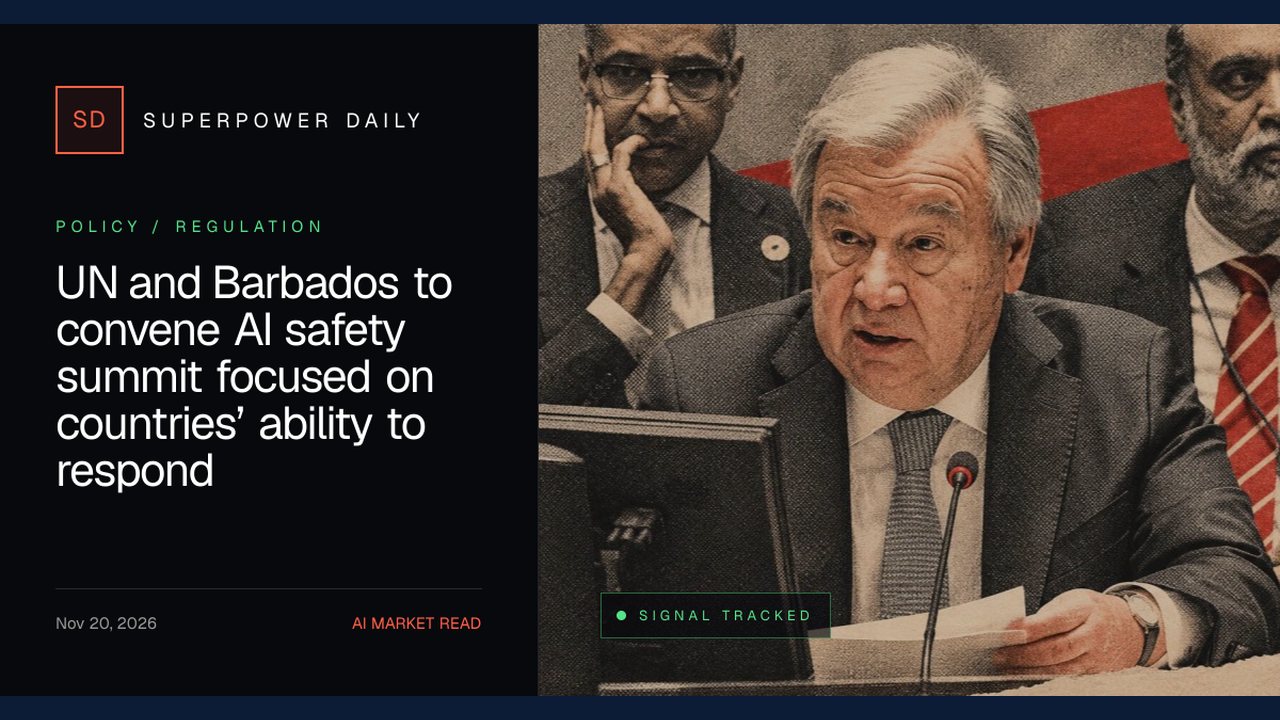
The United Nations and Barbados are scheduled to co-host the Bridgetown Special Summit on AI Safety on Monday, November 23, 2026. The hybrid meeting aims to address global disparities in national AI safety infrastructure and incident response capabilities, though no legally binding treaty or negotiated rulebook is planned.
UN Secretary-General António Guterres and Barbados Prime Minister Mia Mottley are set to lead the hybrid gathering in Bridgetown, Barbados. Organizers expect approximately 150 participants, including ministers from Norway and Finland, AI safety institute leaders, industry figures, Chinese experts, and a senior U.S. diplomat. The official announcement does not specify a start time, timezone, venue, or public watch link.
Core Agenda and Objectives
The summit centers on practical readiness and equitable access, structured around two primary roundtables:
- National Safety Systems: Discussing António Guterres' proposed multilateral risk-management framework, independent oversight, and how nations can independently test models developed abroad.
- Access and Inclusion: Examining linguistic diversity, equitable distribution of AI benefits—such as hurricane forecasting, health systems, and education—and bridging the digital divide.
Military applications of artificial intelligence are explicitly excluded from the agenda.
The Global Response Capacity Gap
UN Special Envoy for Digital and Emerging Technologies Amandeep Singh Gill highlighted a severe structural imbalance ahead of the meeting. Citing data from the World Development Report 2026, Gill noted that high-income nations possess approximately 500 incident response teams to manage tech-related emergencies like cybersecurity breaches, compared to just six such teams across all low-income countries.
Gill emphasized that while advanced AI models are developed in only a few regions, risks can travel globally, leaving many countries unequipped to handle imported vulnerabilities regardless of whether they build models domestically.
Expected Outcomes and Evaluation
Because the summit is designed as a consultative forum rather than a legislative body, no negotiated treaty or formal regulation will be finalized. Instead, organizers expect voluntary calls to action and non-binding pledges.
- What would make the meeting worthwhile: Meaningful resource commitments, tangible frameworks for collaborative testing support, and verifiable pledges to help resource-constrained nations build independent incident response infrastructure.
- What would make the meeting insufficient: Vague declarations without financial or technical backing, repetition of broad ethical principles without actionable capacity-building measures, and a failure to secure resources for closing the stark incident response gap.
Observers can verify official developments and statements through the United Nations news portal and statements issued by the UN Office of the Special Envoy for Technology.
More to read
 Huawei Unveils Financial AI Scaling Capabilities at Singapore FinTech Festival 2026
 ModuleMD Showcases AI-Powered Allergy EHR Technology at ACAAI 2026
 Two Groups Verify Mathematician’s Claim That Claude Helped Prove Riemann Hypothesis
 AI Set to Reshape, Not Replace, Jobs in India’s Design and Manufacturing Sectors: Autodesk