10‑Millisecond Light Pulse Enables Ultra‑Sensitive, Room‑Temperature NO₂ Sensors
· GlobeWire Daily Business Desk · Source: www.prnewswire.com
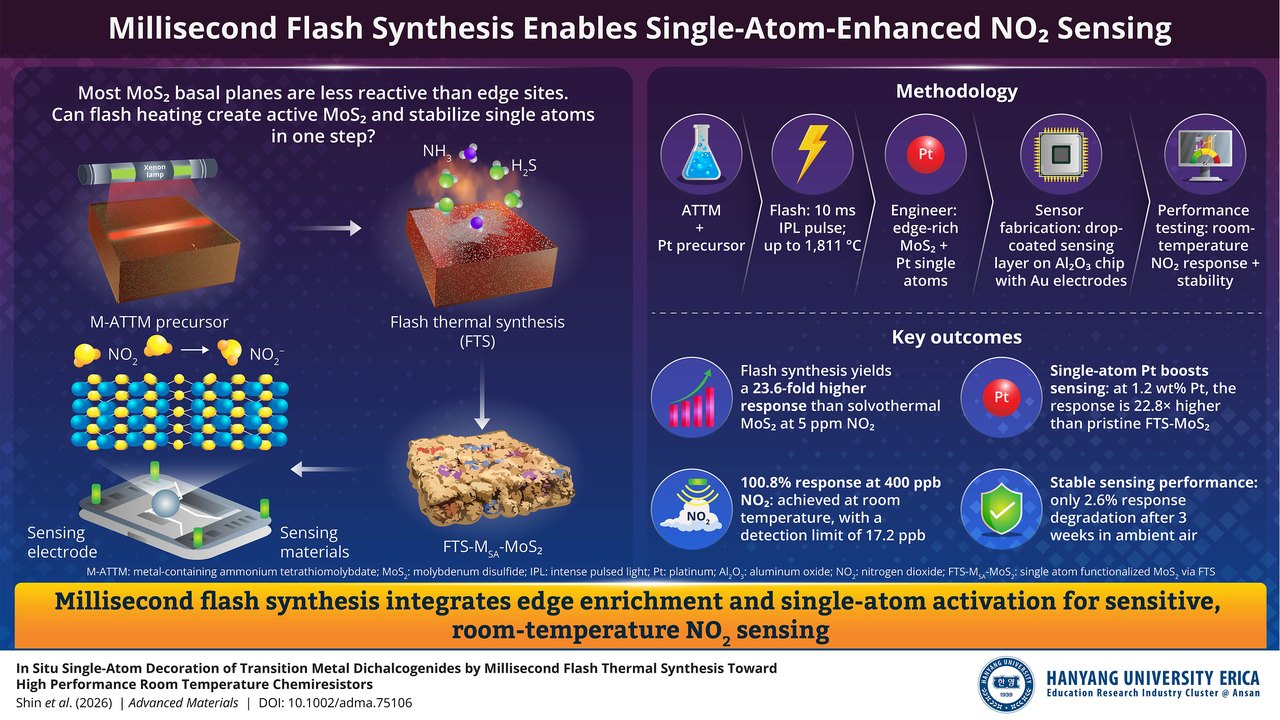
Image: Hanyang University ERICA — Creative Commons
A rapid flash‑thermal method reshapes molybdenum disulfide
Researchers at Korea Advanced Institute of Science and Technology (KAIST) and Hanyang University‑ERICA have demonstrated that a single 10‑millisecond pulse of intense light can transform a molybdenum‑containing precursor into ultra‑thin, edge‑rich MoS₂ flakes. The brief heating spikes the material temperature to roughly 1,811 °C before it cools instantly in ambient air. During this flash, individual atoms of platinum, iridium or gold can be incorporated directly into the crystal lattice, avoiding the particle agglomeration that typically occurs with conventional furnace treatments.
Sensor performance leaps forward
In laboratory tests, the flash‑made MoS₂ showed a 23.6‑fold stronger electrical response to 5 ppm nitrogen dioxide (NO₂) compared with MoS₂ produced by a standard solvothermal route. Adding 1.2 wt % platinum during the flash further amplified the response, delivering a 100.8 % signal change when exposed to 400 ppb NO₂ at room temperature. The platinum‑decorated sensor could reliably detect NO₂ concentrations as low as 17.2 ppb.
Key performance metrics reported by the authors include:
- Selectivity: The sensor’s response to NO₂ was markedly higher than its response to several other common gases tested (specific gases not listed in the release).
- Stability: After 25 exposure‑and‑recovery cycles, the signal remained consistent. Over a three‑week period in ambient air, the response dropped by only 2.6 %.
- Energy consumption: The flash process consumes 8.6 kJ of electrical energy per gram of material, a figure that is modest compared with multi‑hour furnace heating.
Energy efficiency and scalability prospects
Because the light pulse can illuminate a relatively broad area, the technique may be scaled more easily than batch furnace methods that require prolonged heating times. The authors suggest that the low per‑gram energy demand and the single‑step synthesis—simultaneously forming the MoS₂ flakes and anchoring isolated catalyst atoms—could lower production costs for high‑performance chemiresistive sensors.
Practical implications and next steps
The ability to detect NO₂ at sub‑20 ppb levels at room temperature is significant for air‑quality monitoring, where many existing sensors require elevated temperatures to achieve comparable sensitivity. Potential applications include:
- Urban air‑quality stations that need low‑power, compact detectors.
- Industrial safety systems for early leak detection of nitrogen oxides.
- Wearable or portable devices where battery life is a constraint.
However, the study remains at the laboratory‑scale. Real‑world performance under fluctuating temperature, humidity, and interferent gases has not yet been demonstrated. Commercial integration will also require validation of long‑term durability beyond the three‑week ambient test and assessment of manufacturing reproducibility.
Confirmed facts vs. open questions
| Confirmed (from the paper) | Still uncertain (requires further study) | |---|---| | 10 ms light pulse reaches ~1,811 °C and cools rapidly. | How the flash process behaves on larger substrates or roll‑to‑roll production lines. | | Single‑atom Pt incorporation yields 100.8 % response at 400 ppb NO₂. | Sensor performance under high humidity, temperature swings, or in the presence of complex gas mixtures. | | Energy use is 8.6 kJ g⁻¹. | Cost comparison with existing commercial NO₂ sensor technologies. | | Stability over 25 cycles and three weeks in air (2.6 % loss). | Lifetime over months or years in field deployments. |
How readers can verify the announcement
The full research article, titled “In Situ Single‑Atom Decoration of Transition Metal Dichalcogenides by Millisecond Flash Thermal Synthesis Toward High Performance Room Temperature Chemiresistors,” was posted online on July 7 2026 and appeared in the peer‑reviewed journal Advanced Materials on September 21 2026. The press release summarizing the work is available at the official PR Newswire link: https://www.prnewswire.com/news-releases/hanyang-university-erica-scientists-find-that-a-10-millisecond-flash-could-help-build-more-sensitive-gas-sensors-302924418.html. Interested readers can also consult the university’s project page (https://www.hanyang.ac.kr/web/eng/erica-campus1) for additional context and potential updates on follow‑up studies.
--- This article is based solely on the verified press release and the cited Advanced Materials paper. No additional interviews or unpublished data were used.
AI-assisted reporting; source claims are attributed and have not been independently verified.
More to read
 Global ESG Reporting Software Market Projected to Reach $4.48 Billion by 2031, Driven by Integrated Disclosures
 Sentral Expands Residential-Hospitality Portfolio with Fort Lauderdale Debut and Major San Diego Addition
 RCG Ventures Closes Fund VIII Above Target at $515 Million, Citing Strong Institutional Demand
 Duolingo Faces Securities Class Action Lawsuit: What Investors Should Know
Trending on GlobeWire Daily
Selected from recent coverage and related topics; not live search rankings.
 India Post Announces 24 Staff Car Driver Vacancies in Tamil Nadu Circle for 2026
 Four Years After Historic UN Biodiversity Deal, Global Targets Face Severe Implementation Gaps
 Fanzart Seeks Business Development Specialist for On-Site Role in Ranchi
 Hollywood Coalition Backs Federal Film Tax Incentive While Pushing for Broader Market Overhauls
 American India Foundation Seeks Chief Finance and Operating Officer for New Delhi Leadership Team
 Unison Leader Argues Public Sector Workers Are Left as 'Afterthought' Compared to North Sea Oil Focus