DBT Junior Research Fellowship Programme: Structure, Eligibility, and Application Process
· GlobeWire Daily Public Services Desk · Source: www.govtschemes.in
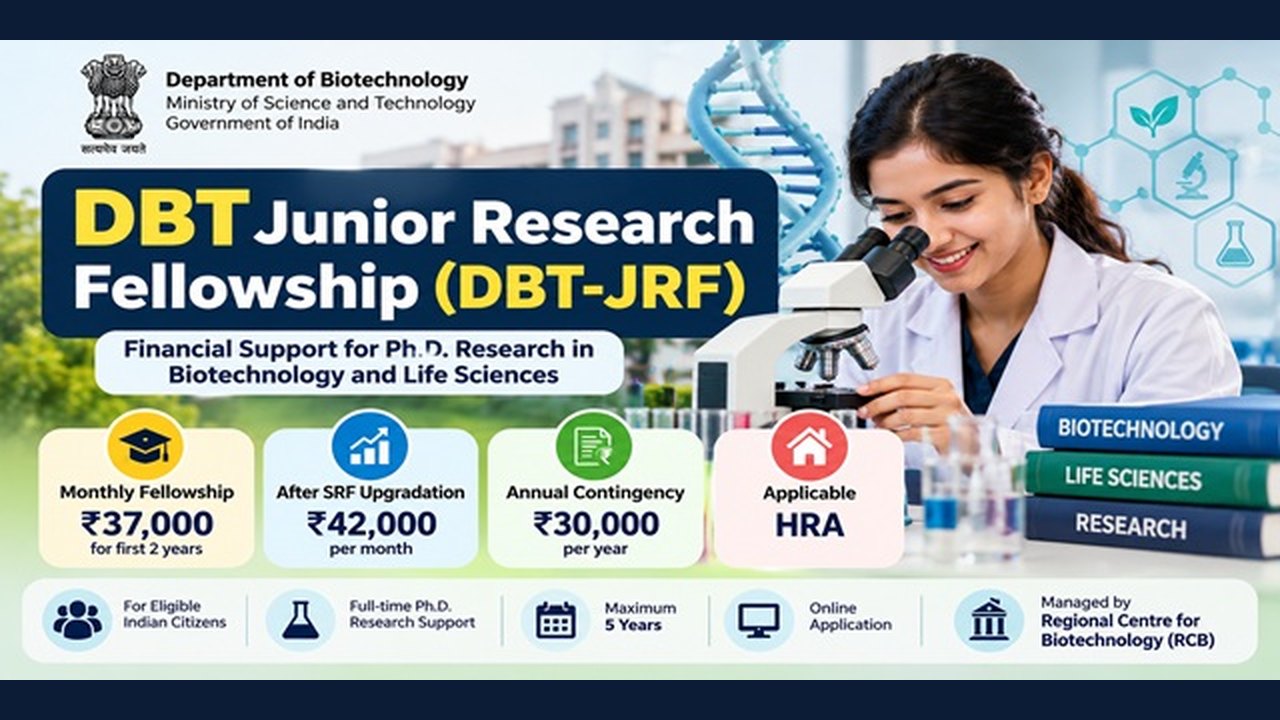
Image: www.govtschemes.in · Photo source · Resized and letterboxed to 16:9; no AI generation
Overview of the DBT-JRF Programme
The DBT Junior Research Fellowship (DBT-JRF) Programme, launched in 2004 by the Department of Biotechnology (DBT), Ministry of Science and Technology, Government of India, provides financial assistance to eligible Indian students pursuing full-time Ph.D. research in biotechnology, life sciences, and related disciplines. Managed through the DBT-HRD Project and Management Unit at the Regional Centre for Biotechnology (RCB) in Faridabad, the scheme helps doctoral candidates focus on their academic and research goals.
Fellowship Stipend and Financial Benefits
Selected fellows receive financial support for up to five years, subject to programme rules and satisfactory progress:
- Junior Research Fellow (JRF): ₹37,000 per month for the first two years.
- Senior Research Fellow (SRF): ₹42,000 per month for the remaining three years, applicable after successful research assessment and upgradation.
- Contingency Assistance: ₹30,000 per year on a pro-rata basis for eligible research-related expenses.
- House Rent Allowance (HRA): Provided where applicable, according to Government of India and Department of Science and Technology (DST) guidelines if institutional accommodation is unavailable.
Examination Routes and Eligibility
Eligibility criteria vary depending on the examination route used to apply:
- Standalone BET Route: The Biotechnology Eligibility Test (BET) served as a standalone examination route up to BET 2026, which categorized successful candidates into Category-I (eligible for the DBT-JRF fellowship) and Category-II (not eligible for the fellowship, but open to project positions under specific rules).
- Joint CSIR–UGC–DBT JRF-NET Route: Introduced from December 2026, candidates must follow the eligibility criteria published in the official Joint CSIR–UGC NET information bulletin, which includes specific marks requirements (such as 55% for general category master's degree holders and 50% for reserved categories) and subject code 703 for Life Sciences and Bio-Technology.
Application and Activation Process
- Examination Registration: Candidates applying through the December 2026 cycle must register via the Joint CSIR–UGC NET portal, select subject code 703, and complete the NTA application guidelines.
- Award Letter Application: Qualified candidates must submit academic, identity, and category documents through the official DBT-JRF portal to obtain their award letter.
- Ph.D. Admission & Activation: Fellows must secure admission to a recognized Indian university or institution, submit required bank and joining details, and complete the activation process. Funds are disbursed directly to the host institution's bank account rather than personal accounts.
Verification and Official Contacts
Applicants should always verify guidelines, deadlines, and current notifications directly through the official DBT-JRF portal and the Regional Centre for Biotechnology (RCB) website. For queries, contact the DBT-HRD Project and Management Unit at regional facilities or via official email channels.
AI-assisted reporting; source claims are attributed and have not been independently verified.
More to read
 NTA NIFTEE 2027 Application Process Opens: Dates, Eligibility, and Exam Structure
 Government Offers Up to ₹25 Lakh Subsidized Loans for Poultry Farming Under NLM: Check Eligibility and Application Process
 Reserve Bank of India Announces Assistant Recruitment 2026 – Eligibility, Application Process and Selection Overview
 Rajasthan Opens B.Ed. Financial Assistance Scheme for Sahariya Students: Deadlines, Amounts, and Application Process
Trending on GlobeWire Daily
Selected from recent coverage and related topics; not live search rankings.
 Maharashtra Boosts Student Support: Up to ₹80,000 for OBC, VJ, NT & SBC Learners Without Government Hostel Seats
 European Defence Officials Urge Early Interoperability Testing and Open Architectures
 Meta Open-Sources Astryx, a Customizable Design System Built for React and AI Agents
 openGym Launches as Open-Source Routine and Workout Tracker
 Chhattisgarh Yuva Darshan Yojana 2026-27: Educational Tours for Government School Students
 BMW C600 Sport and C650GT: Specifications & buying guide