Rare Mutual Occultation of Jupiter's Moons Ganymede and Io Captured in New Astronomy Video
· GlobeWire Daily Science Desk · Source: science.nasa.gov
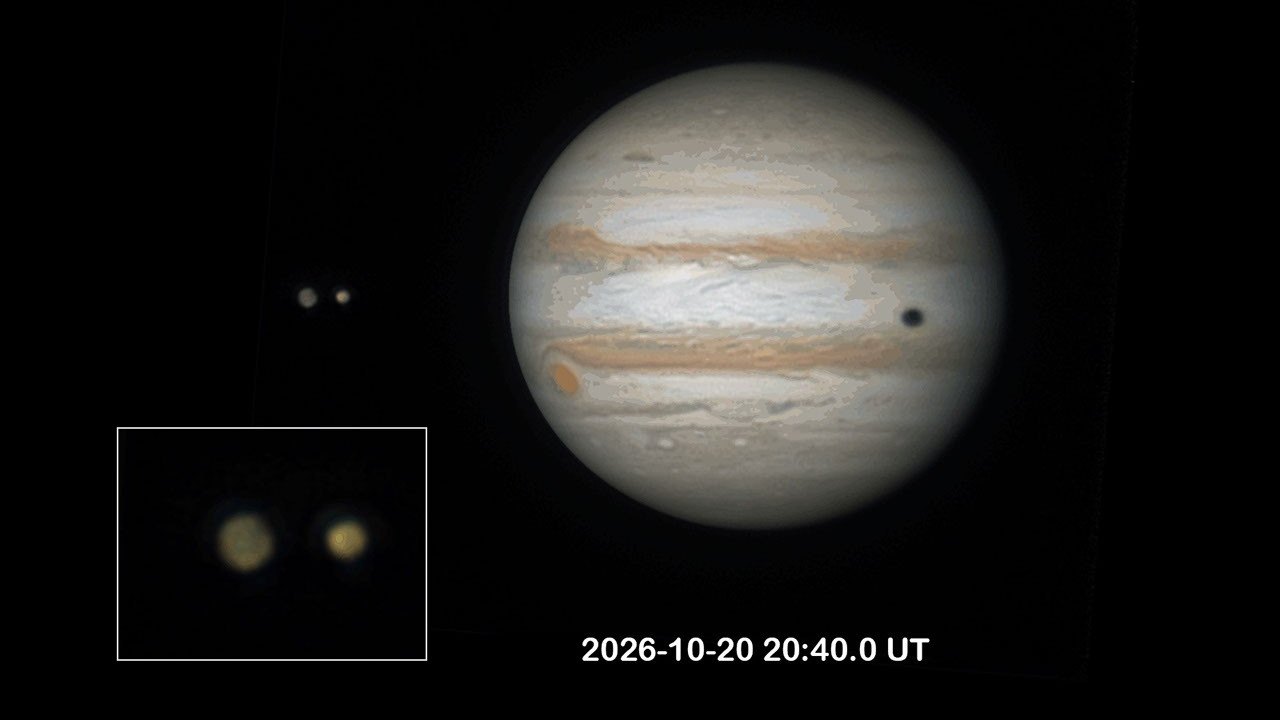
Image: science.nasa.gov — Creative Commons
A Rare Jovian Alignment
Jupiter, one of the most heavily orbited planets in our Solar System, recently played host to a rare celestial event. According to NASA's Astronomy Picture of the Day (APOD) for October 28, 2026, two of the planet's massive Galilean moons—Ganymede and Io—passed directly in front of one another. The event, which occurred on October 20, 2026, captured Ganymede briefly blocking Io from view.
This phenomenon is scientifically classified as a mutual occultation, an occurrence where one astronomical object passes in front of another, completely or partially obscuring it from an observer's perspective. In addition to the occultation, the featured footage also shows Ganymede casting its distinct shadow onto the right side of Jupiter itself, creating conditions equivalent to a solar eclipse for any theoretical vantage point within that shadow.
Understanding the Mechanics of Jovian Occultations
Witnessing mutual occultations among Jupiter's Galilean moons is exceptionally rare. These alignments are only visible from Earth during specific orbital windows when our planet shares an edge-on view of the moons' orbital planes.
This rare viewing angle occurs approximately once every six years, coinciding with the timing of Jupiter's equinox, a period when the giant planet appears less tilted relative to Earth's line of sight. Jupiter currently boasts a recognized family of 115 natural satellites, trailing Saturn's leading count of 293 moons.
Practical Implications and Reader Verification
For astronomy enthusiasts and amateur stargazers, understanding these rare orbital mechanics highlights the precise timing required to observe planetary dynamics. While Saturn holds the record for the most known moons in the Solar System, Jupiter's active system of Galilean moons continues to offer dynamic observational opportunities during its equinox phases.
Readers interested in examining the original footage and reviewing the professional astronomer's explanation can access the official release directly through NASA's Astronomy Picture of the Day archive.
What is Confirmed:
- Ganymede and Io underwent a mutual occultation on October 20, 2026.
- The event involved Ganymede blocking Io and casting a shadow on Jupiter.
- Such alignments occur roughly once every six years during Jupiter's equinox when orbits appear edge-on from Earth.
What Remains Unknown / Contextual:
- Exact localized telescope requirements for amateur viewing of this specific event were not detailed in the summary release.
Readers can verify these details and view the featured media by visiting the official source page at [NASA APOD](https://science.nasa.gov/image-article/apod-2026-october-28-the-mutual-occultation-of-ganymede-and-io/).
AI-assisted reporting; source claims are attributed and have not been independently verified.
More to read
 Mysterious 1,000-Mile Cloud on Mars May Reveal Hitherto Unseen Atmospheric Physics
 OpenAI’s Latest Science Breakthroughs Draw Criticism Over Expert "Gatekeeping"
 Vice-President Urges Global Research Partnerships at Dr NTR University Ruby Jubilee
 Vice-President C.P. Radhakrishnan Urges Universities to Prioritize Medical Research
Trending on GlobeWire Daily
Selected from recent coverage and related topics; not live search rankings.
 France Pledges to Replace Parcoursup Admissions System by 2028 Amid Student Protests
 Paris Jackson Sues Michael Jackson Estate Over Executor Compensation, Seeks Reduction Amid Disclosure Dispute
 How Independent Montreal Developer Red Barrels Revolutionized Horror Gaming Over 15 Years
 Nintendo Switch Software Landscape Highlights Timeless Classics Amid Upcoming Hardware Transition
 Liverpool Extends Penalty Dominance Over Chelsea to Reach Carabao Cup Quarter-Finals
 Federal Reserve Leaves Interest Rates Unchanged Amid Rising Inflation Ahead of Midterms