NASA’s James Webb Space Telescope Maps Supernova Dust to Reveal Clues About Star Evolution in Cassiopeia A
· GlobeWire Daily Editorial Desk
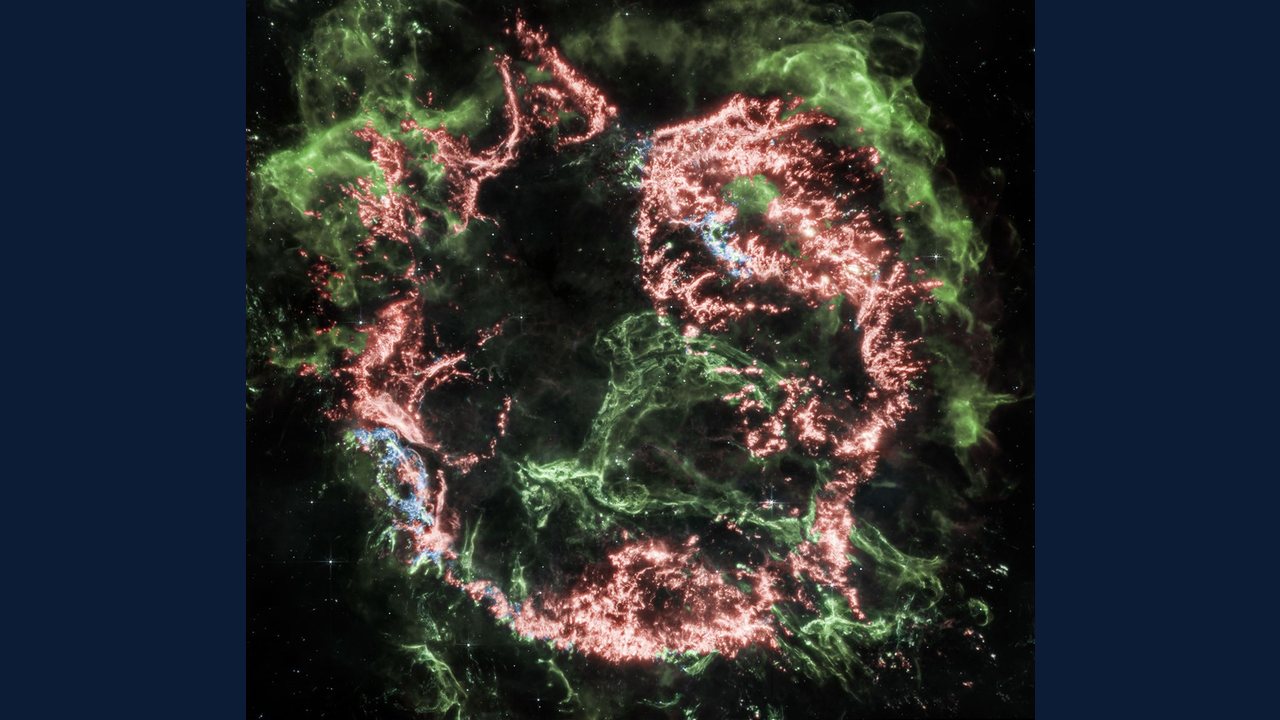
NASA’s James Webb Space Telescope has captured detailed mid-infrared observations of the supernova remnant Cassiopeia A (Cas A), offering astronomers new data to study the structure and evolution of its progenitor star. The findings, published Monday in *The Astrophysical Journal Letters*, indicate that the interior of the star may have experienced a dramatic shell merger shortly before its explosion.
Mapping Dust Composition in Cassiopeia A
Researchers utilized high-resolution data from Webb to map individual, solar-system-sized dust clumps across the supernova remnant. By analyzing the composition of these dust grains, the research team found evidence suggesting that internal layers—specifically the oxygen- and carbon-burning shells—churned and merged shortly before the core collapse.
- Silica and Carbon Dust: Observations of targets inside Cas A's reverse-shocked region revealed areas containing predominantly silica dust, while another region was dominated by carbon dust.
- The Green Monster: A structure previously discovered by Webb was found to contain complex magnesium silicates originating from material shed by the star prior to the explosion.
Collaboration and Methodology
To guide Webb's high-resolution instruments, scientists used earlier data from the retired Spitzer Space Telescope to isolate specific regions of interest. Additional context was gathered by pairing Webb's observations with data from NASA’s Chandra X-ray Observatory and the JAXA-led XRISM mission.
According to Tea Temim, lead author of the study and a research scientist at Columbia University, internal material circulation can alter a star's structure and change the chemical abundances visible in supernova ejecta. Co-author Dan Milisavljevic, an associate professor at Purdue University, noted that analyzing dust chemistry helps researchers connect the modern makeup of the remnant back to the characteristics of the original star.
Astronomers can verify the published methodology and access the underlying research paper through *The Astrophysical Journal Letters*.