Scientists Report Tentative Hints of Potential Biosignature Gases on Distant Exoplanet K2-18b
· GlobeWire Daily Editorial Desk · Source: www.bbc.com
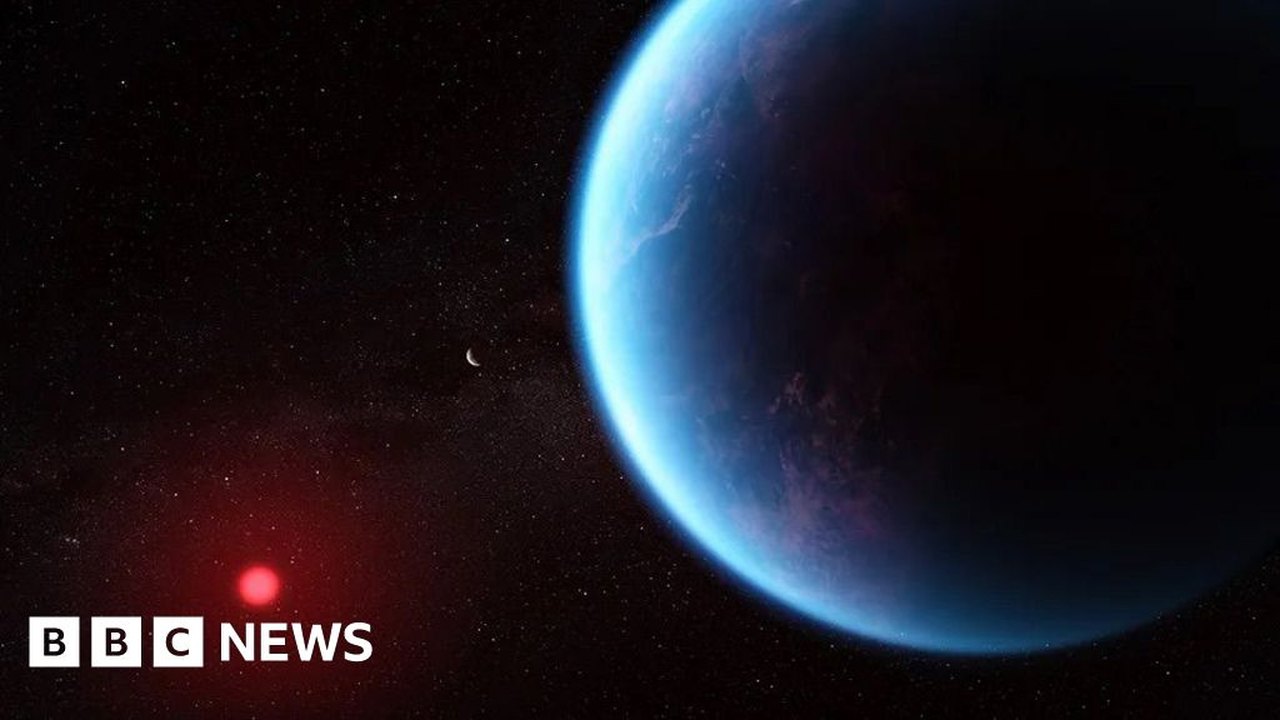
Image: www.bbc.com · Photo source · Resized and letterboxed to 16:9; no AI generation
Researchers studying data from the James Webb Space Telescope have reported tentative signs of molecules associated with life in the atmosphere of exoplanet K2-18b. Scientists emphasize that these findings require further data and verification before any definitive conclusions can be drawn.
A research team led by Professor Nikku Madhusudhan at the University of Cambridge analyzed atmospheric data from K2-18b, a planet located approximately 124 light-years away. The observations suggest the presence of dimethyl sulphide (DMS) and dimethyl disulphide (DMDS), gases that on Earth are produced by simple organisms such as marine phytoplankton and bacteria.
Understanding the Data and Scientific Caution
- Significance Level: The latest findings are reported at a three sigma level (approximately 99.7% certainty), which is an improvement over previous estimates but falls short of the five sigma threshold (99.99999%) typically required in physics for a formal discovery claim.
- Timeline: Professor Madhusudhan indicated that the team hopes to gather additional observations to test these results further, suggesting that stronger data could potentially be obtained within one to two years.
- Independent Perspectives: Independent astronomers and researchers note that even with higher statistical certainty, establishing a biological origin remains challenging because non-biological or geological processes could potentially produce similar chemical signatures.
Alternative Explanations and Ongoing Debate
The scientific community maintains a healthy debate regarding the interpretation of K2-18b's atmospheric composition. While the Cambridge team hypothesizes the presence of a liquid ocean that might absorb ammonia, other researchers have proposed alternative scenarios, such as a molten rock surface or a mini gas giant without a solid surface.
Independent experts emphasize the need for caution, noting that analyzing starlight filtering through distant atmospheres is exceptionally difficult. The research has been published in The Astrophysical Journal Letters, and further studies and peer review will be necessary to evaluate the data.
Practical Implications and Verification
- How to Verify: Readers interested in the underlying research can consult the published paper in The Astrophysical Journal Letters or review statements from institutions like Cambridge University and NASA.
- Ongoing Research: Scientists continue to model planetary atmospheres and test whether non-living processes can account for the detected chemical signals in laboratory settings.
AI-assisted reporting; source claims are attributed and have not been independently verified.
More to read
 Nissan Global Design Chief Hints at Round Headlights for Potential R36 GT-R
 Actor Ben Wang Hints at Potential Marvel X-Men Casting News Soon
 Jessica Lange Hints at Potential Retirement After Decades-Long Career
 Garmin Hints at Potential Price Increases Amid Rising Component Costs