AI’s Hidden Storage Bill: What Inference Leaves Behind
· GlobeWire Daily Editorial Desk · Source: www.technologyreview.com
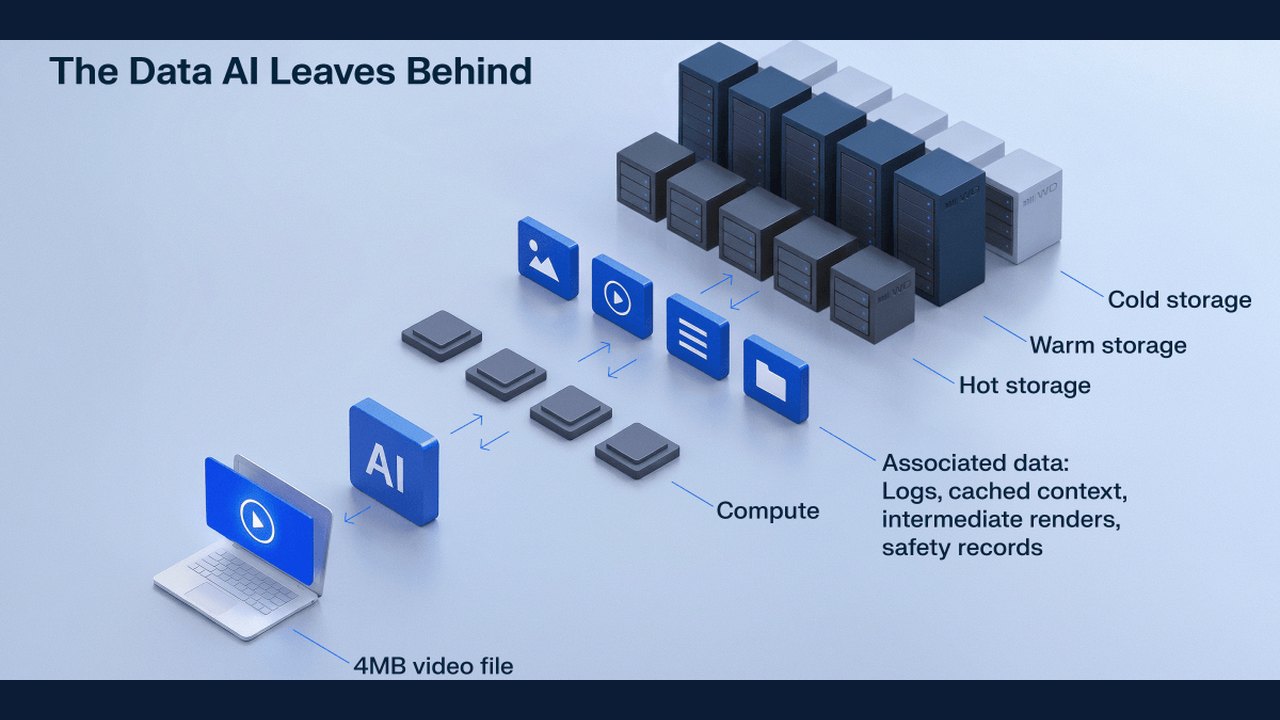
Image: MIT Technology Review · Photo source · Resized and letterboxed to 16:9; no AI generation
When business leaders evaluate artificial intelligence budgets, attention frequently focuses on high-performance accelerators, power consumption, and silicon waitlists. However, reports and industry analyses indicate that back-end data storage costs are often omitted from initial infrastructure planning.
The Shift from Training to Inference
Traditional infrastructure discussions have centered on training models, a finite process that consumes compute resources and eventually concludes. In contrast, inference runs continuously whenever a model responds to a prompt. Every inference request leaves data behind, meaning the data footprint grows alongside scaling usage.
According to industry reports and internal measurements, back-end data generation can significantly exceed the size of the final user-facing output. For instance, temporary files, logs, cached contexts, and safety records associated with a single short AI-generated video clip can multiply the storage footprint considerably compared to the delivered file size.
Industry projections suggest that inference demand will continue to expand significantly faster than training demand over the remainder of the decade, driving a substantial share of total data center growth.
Managing the AI Data Life Cycle
Unlike compute demand, which fluctuates with training cycles and hardware refreshes, accumulated data does not automatically decrease when workloads slow. Organizations increasingly retain logs, synthetic outputs, and inference results, transforming historical archives into potential inputs for future workloads like retrieval-augmented generation (RAG).
Key practical implications include:
- Budget Imbalances: Treating storage as a minor fraction of compute costs can lead to unexpected operational expenses as data volumes compound.
- Access Requirements: Organizations increasingly require faster retrieval from archives to support continuous inference workflows.
- Tiered Architecture: Balancing expensive hot-tier performance with cost-effective high-capacity storage helps manage growing data volumes across the life cycle.
Verifying Infrastructure Requirements
IT decision-makers reviewing their organizational budgets can verify their current standing by examining data retention policies, aligning procurement with the actual data life cycle, and modeling how scaling AI usage would impact storage expenditure. Organizations can review original industry white papers and consult IT infrastructure benchmarks to assess whether their current operational expenditure correctly accounts for long-term data retention.
AI-assisted reporting; source claims are attributed and have not been independently verified.
More to read
 AI Inference Software Market Projected to Reach USD 545.33 Billion by 2034
 Study Reveals Most Workers Fail to Verify AI Outputs as Training Lags Behind Adoption
 Strata Brings Local Qwen3.8-Flash-Next Inference to Consumer Hardware with One-Click Install
 After the Funeral: The Economic and Emotional Toll on Families Left Behind by Yemen’s Conflict
Related coverage
Related reporting available at publication.
AI Inference Software Market Projected to Reach USD 545.33 Billion by 2034Study Reveals Most Workers Fail to Verify AI Outputs as Training Lags Behind AdoptionStrata Brings Local Qwen3.8-Flash-Next Inference to Consumer Hardware with One-Click InstallAfter the Funeral: The Economic and Emotional Toll on Families Left Behind by Yemen’s Conflict AI-Generated Code Security Shows First Major Improvement, But Risks Remain
 AI Success Depends on Business Outcomes Rather Than Usage Vanity Metrics