Asymptote Labs Releases Beacon: Open-Source Cross-Harness Memory Layer for AI Coding Agents
· GlobeWire Daily Editorial Desk · Source: github.com
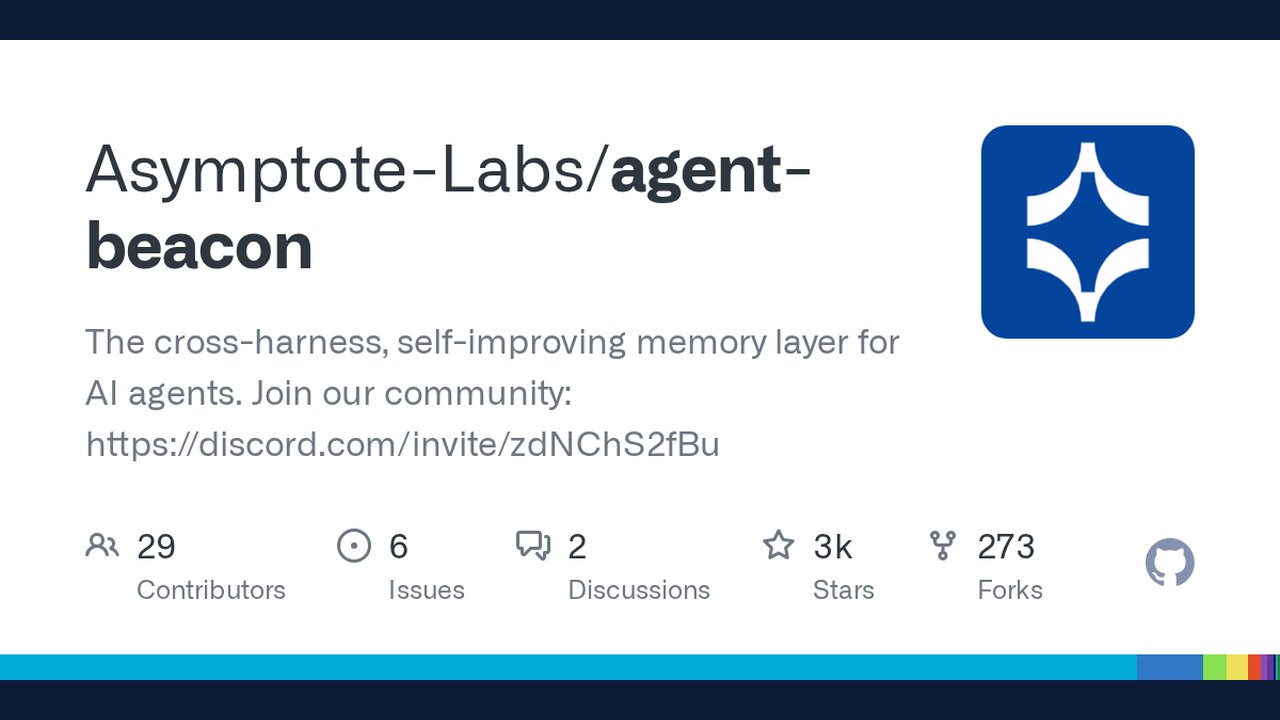
Image: GitHub · Photo source · Resized and letterboxed to 16:9; no AI generation
Asymptote Labs Releases Beacon: Open-Source Cross-Harness Memory Layer for AI Coding Agents
Asymptote Labs has published Beacon, an open-source memory layer designed to capture, normalize, and reuse AI coding agent session history across more than 20 development harnesses. The project addresses a persistent fragmentation problem: knowledge gained in one tool—Claude Code, Cursor, Codex, OpenCode, Cline, or others—typically remains trapped in that tool's proprietary history format.
What Beacon Does
- Cross-harness capture: Records full session traces—prompts, responses, tool calls, commands, file edits, approvals, MCP activity, and token usage—from Claude Code, Cursor, Codex, OpenCode, Cline, and 20+ other harnesses into a single local JSONL store.
- Knowledge compounding: Identifies reusable workflows, debugging patterns, corrections, and repository conventions so that a problem solved once informs future agents, regardless of which harness they run in.
- Shared agent memory: Exposes reviewed knowledge through Model Context Protocol (MCP) servers and Agent Skills, allowing any connected agent to retrieve relevant project memory.
- Exact session replay: Provides a local terminal browser and web dashboard for inspecting traces, event timelines, token bills, and file diffs without sending data off the machine.
- Local-first portability: Stores data in durable JSONL, supports explicit destination selection (local only or optional Beacon Cloud), and avoids harness lock-in.
Installation and Setup
Beacon offers multiple installation paths:
- Linux: `.deb` and `.rpm` packages for Debian, Ubuntu, Fedora, RHEL, Rocky, and Alma. The installer downloads the package, verifies it against the release `checksums.txt`, and installs via `apt-get` or `dnf`. Users can pin a specific version with `BEACON_VERSION=`.
- Windows: x64 MSI from the latest GitHub release.
- User-mode (no root): Tarball installation documented in the Linux install guide.
- Verification: Release provenance can be checked with `gh attestation verify "${PKG}" --repo asymptote-labs/agent-beacon`, confirming the package was built by the repository's release workflow.
Interactive setup runs through `beacon.sh`, which signs the user in (no data forwarded at sign-in) and presents a confirm screen that explicitly names the account, operator (Asymptote Labs), destination, and capture mode before enabling Beacon Cloud forwarding. A Local option keeps all data on the machine. The wizard also installs Beacon Skills into `~/.agents/skills` and `~/.claude/skills` unless disabled, and can register the Beacon Cloud MCP server in supported harnesses (Claude Code, Codex CLI, Cursor, VS Code, Gemini CLI, OpenCode) with OAuth-based sign-in—no tokens written to disk.
Skills, Lenses, and Extensibility
- Beacon Skills: Agent Skills that recall and distill project memory from traces. Installable via plugin marketplaces (e.g., `/plugin marketplace add asymptote-labs/agent-beacon` in Claude Code), package managers (`pi install git:github.com/asymptote-labs/agent-beacon`), Kiro Powers, the `skills` CLI (`npx skills add asymptote-labs/agent-beacon`), or by copying `agent-skills/skills/*` into a project directory.
- Lenses: Purpose-built, single-HTML-file views of a trace (files changed with diffs, itemized token bill, security review by risk, approval timeline). Lenses run in a sandboxed frame with no access to Beacon or the dashboard and no ordinary network APIs. Developers can author custom lenses (`beacon lenses spec`, `lint`, `preview`, `add`). The project cautions: install only lenses you trust with your traces.
Observability and Forwarding
By default, Beacon writes normalized session history to local JSONL. It can also forward the same event stream to existing observability and security infrastructure:
- Splunk, Datadog, Elastic, Microsoft Sentinel, CrowdStrike Falcon LogScale, Sumo Logic, Wazuh
- AWS S3, Google Cloud Storage, CloudWatch
The underlying OpenTelemetry-based event model enables unified querying across tools.
Practical Implications
For development teams using multiple AI coding assistants, Beacon reduces redundant learning: a debugging path discovered in Cursor becomes available to Codex; a testing convention corrected in Claude Code informs OpenCode. The local-first architecture means organizations can evaluate the tool without committing data to an external service. The JSONL export ensures portability and auditability.
How to Verify and Get Started
- Source repository: <https://github.com/Asymptote-Labs/agent-beacon> (MIT license)
- Documentation: Linked from the repository (architecture breakdown, install guides, lenses spec, skills reference)
- Community: Discord invite at <https://discord.com/invite/zdNChS2fBu>
- Release artifacts: GitHub Releases page publishes packages, `checksums.txt`, and build provenance attestations
- Issue tracking: Open issues or submit pull requests on GitHub
No pricing, deadlines, or eligibility criteria are published; the project is open source and free to use. All claims above are drawn from the project's public README and documentation. Independent verification is encouraged by inspecting the source code, release attestations, and local JSONL output.
AI-assisted reporting; source claims are attributed and have not been independently verified.
More to read
 A Pragmatic Playbook for Building Profitable AI Applications in 2026
 Navigating the Risks: The Challenges Facing the Global AI and Tech Landscape
 Canada Launches $2M Challenge for AI Governance Tools That Track Decisions and Ensure Compliance
 Concerns Rise Over AI Sustainability and Data Security
Trending on GlobeWire Daily
Selected from recent coverage and related topics; not live search rankings.
 BMW G310R: Motorcycle Specifications, Facts and Verification Guide
 Yamaha FZR400: Motorcycle Specifications, Facts and Verification Guide
 Maxus EV30: Car Specifications, Facts and Verification Guide
 Forthing T5 EVO: Car Specifications, Facts and Verification Guide
 Huawei Mate 60: Smartphone Specifications, Facts and Verification Guide
 Redmi K70: Smartphone Specifications, Facts and Verification Guide