Google’s Gemini 4 Argon Powers Five Innovative 3D and Interactive Projects
· GlobeWire Daily Editorial Desk · Source: blog.google
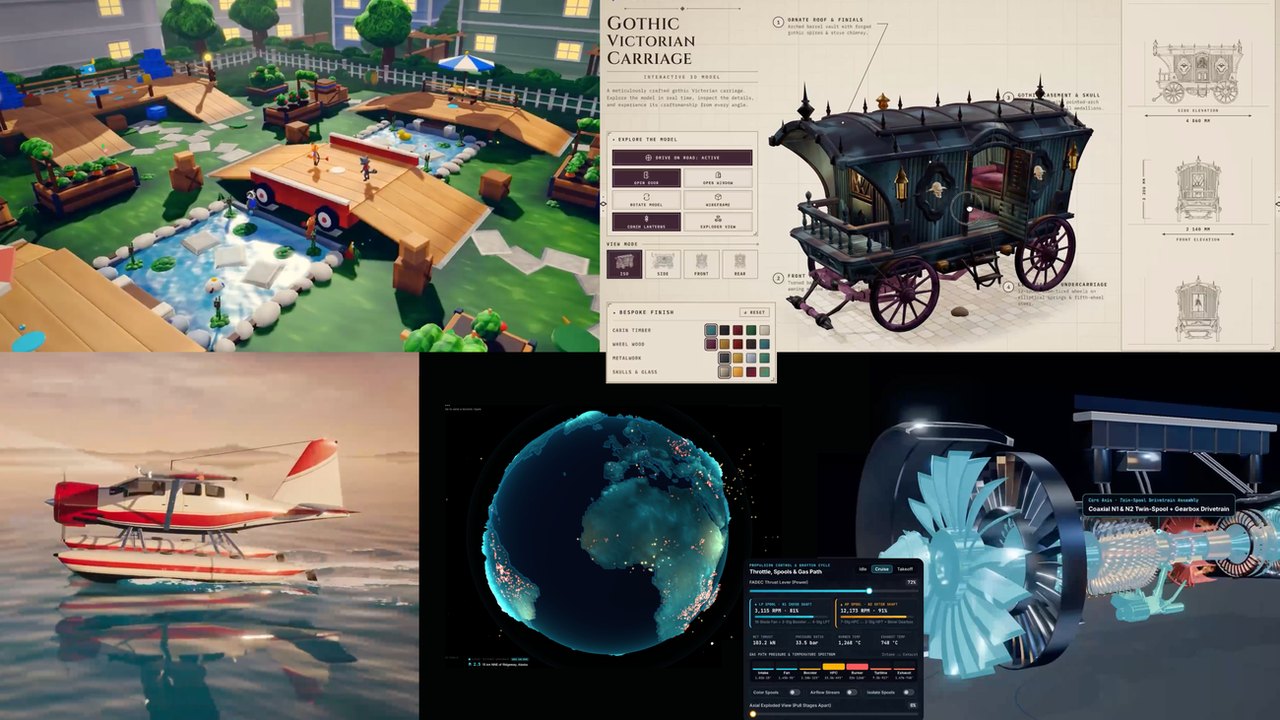
Image: Google · Photo source · Resized and letterboxed to 16:9; no AI generation
Google has unveiled Gemini 4 Argon, a new frontier AI model that excels at complex, multi‑step tasks such as coding, mathematics, and 3D world building. The model was released last week and is now available to developers and enterprises through the API in AI Studio, the Gemini platform, and for paid Pro and Ultra subscribers.
Five community projects showcase Argon’s capabilities:
• Real‑time tectonic shockwave globe – Alex Patrascu used Argon to combine NASA’s live wildfire feed with USGS seismic data, producing an interactive 3D globe that animates shockwaves and hotspots.
• Seaplane simulation – Lumina Bench demonstrated Argon’s spatial reasoning by rendering a realistic 3D seaplane with lighting, reflections, and water movement, coordinating multiple elements in a single pass.
• Turbofan jet engine model – Ashutosh Shrivastava leveraged Blender and Three.js to generate a detailed, data‑driven simulation of a high‑bypass turbofan, with live measurements and part‑by‑part specifications.
• Gothic Victorian carriage – The Bugged Dev turned a single image into an interactive 3D experience, complete with functioning doors, flickering lamps, and a responsive undercarriage.
• Multiplayer capture‑the‑flag game – Chong‑U built “Backyard Rascals,” a browser game where cartoon animals race to capture flags, featuring real‑time physics, collisions, and cheering.
These examples illustrate Argon’s strengths in spatial reasoning, mathematical precision, and visual coding, enabling rapid prototyping of complex projects.
How to verify: Developers can access the model via the API, test it in AI Studio, or try it in the Gemini app’s AI Mode. Public demos are available on the Google AI blog and on social media channels where creators share their builds.
Practical implications: With Argon, teams can accelerate development cycles for games, simulations, data visualizations, and interactive tools, reducing the need for manual coding and rendering.
Future outlook: As Argon continues to improve, it is expected to support even more domains such as finance, legal, and cybersecurity, expanding the range of complex tasks it can handle.
AI-assisted reporting; source claims are attributed and have not been independently verified.
More to read
 Google Enhances Gemini with In-App Document Editing and Interactive Previews
 Google Details Safety and Security Measures for Gemini 4 Argon
 Google Announces Gemini 4 Argon: Capabilities and Availability Reported
 Google Chrome Introduces Enhanced Autofill Powered by Gmail and Gemini
Trending on GlobeWire Daily
Selected from recent coverage and related topics; not live search rankings.
 Madhya Pradesh Government Plans Revenue Generation from 117-Year-Old Edward Villa in Mumbai Through Leasing
 iPhone 18 Pro Named TechRadar Product of the Year 2026
 Google Project Suncatcher Runs Gemma 4 AI on Orbiting Satellite and Receives First Response
 Gender Disparities in Eye Care Access Across India Examined
 Satellite Images Show Cyclone Arnab Weakening Over India As New System Brews
 Expanding Green and Blue Spaces Crucial for India's Economic and Public Health, Reports Indicate