ICAR’s Student READY Scheme: Practical Training and Stipend Details for Final‑Year Agriculture Students
· GlobeWire Daily Public Services Desk · Source: www.govtschemes.in
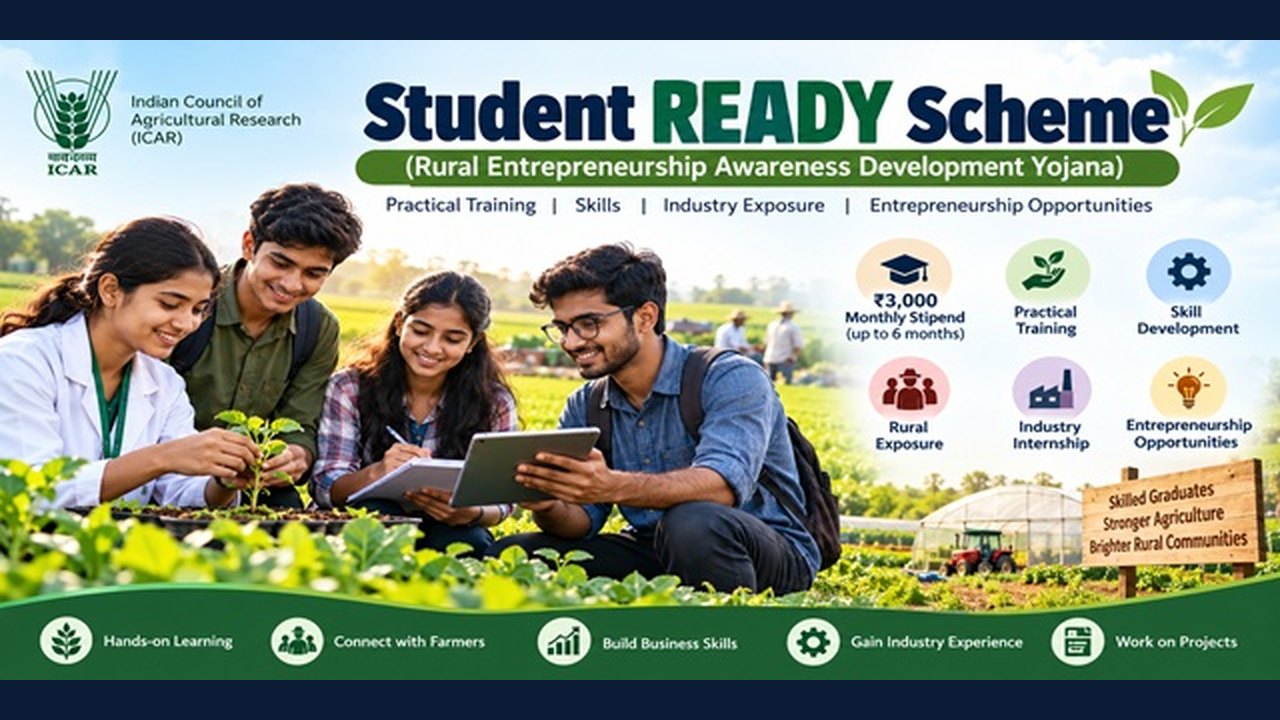
Image: www.govtschemes.in · Photo source · Resized and letterboxed to 16:9; no AI generation
Overview
The Student READY Scheme (Rural Entrepreneurship Awareness Development Yojana) was launched on 25 July 2015 by the Prime Minister and rolled out in agricultural universities from the 2016‑17 academic session. It is administered by the Indian Council of Agricultural Research (ICAR) through its Department of Agricultural Research and Education (DARE). The programme aims to bridge classroom learning with hands‑on experience, industry exposure and entrepreneurship skills for final‑year undergraduate students in agriculture and allied disciplines.
Eligibility
- Enrolled in the final year of an undergraduate degree (B.Sc., B.Tech., B.V.Sc., etc.) in agriculture or an eligible allied field.
- Studying at a participating institution – State Agricultural University, Deemed‑to‑be University, Central Agricultural University or a Central University with an agriculture faculty.
- Institution must be accredited by the National Agricultural Education Accreditation Board (NAEAB) of ICAR.
- Must maintain satisfactory academic performance and good conduct as certified by the college authority.
*Note: The scheme does not have a public online application portal. Registration, placement and stipend processing are coordinated by the individual college’s Student READY coordinator.*
Programme Components
ICAR defines five core components. Students are required to complete any three (subject to discipline‑specific rules):
- Experiential Learning – Business Mode: Running a small agri‑enterprise, handling production, quality, accounting, marketing and sales.
- Experiential Learning – Hands‑On Training & Skill Development: Technical skill modules using university labs and equipment.
- Rural Awareness Work Experience (RAWE): Field visits to farms, interaction with farmers, observation of local practices and challenges.
- In‑Plant Training / Industrial Attachment: Internship or attachment with agro‑industries, food processing units or related organisations.
- Student Projects: Independent or supervised research/project work, from problem identification to final reporting.
Discipline‑specific variations exist (e.g., Dairy Technology replaces RAWE with in‑plant training; Veterinary Science follows a separate internship pattern).
Stipend and Payment
- The original 2016 ICAR guidelines specify a stipend of ₹3,000 per month for a maximum of six months, i.e., up to ₹18,000 in total.
- Stipend is paid directly to the student’s bank account via Direct Benefit Transfer (DBT), linked to Aadhaar, after the university receives funds from ICAR.
- Payment begins when the student starts the first approved component (RAWE, internship, etc.) and stops after six months of approved participation.
- Current rates may have changed; students should confirm the exact amount, payment schedule and required documentation with their university’s coordinator.
How to Enroll
- Check eligibility with the department or Student READY coordinator at your college.
- Obtain the registration form (if any) and submit required documents – Aadhaar, bank details, proof of enrolment, academic record, and any college‑specific declarations.
- Receive a training plan outlining the three components you will undertake, credit allocation and timelines.
- Complete the activities as per the schedule, maintaining attendance and meeting assessment criteria.
- Submit attendance and performance reports to the university for stipend processing.
Verifying Current Rules
- Visit the official ICAR Human Resources Development page or the Student READY section on the ICAR website for the latest circulars.
- Contact the Student READY coordinator at your institution; they can provide the most recent stipend amount, credit requirements and any curriculum updates (e.g., changes introduced by the Sixth Deans’ Committee report, 2026).
- Cross‑check with the Ministry of Agriculture and Farmers Welfare releases for any policy revisions.
Practical Implications
- Skill Development: Graduates acquire real‑world skills that improve employability in agribusiness, food processing, extension services or self‑employment.
- Entrepreneurial Exposure: The business‑mode component encourages students to evaluate the viability of starting their own agri‑ventures.
- Industry Linkage: In‑plant training builds networks with potential employers and familiarises students with modern agro‑industrial processes.
- Financial Support: The stipend helps offset living expenses during the training period, though the amount may be modest.
- Academic Credit: Completed components count toward the final‑year credit requirements, ensuring the scheme integrates with the degree programme.
Bottom line: The Student READY Scheme remains a key channel for practical agricultural education in India. Prospective participants should verify the latest stipend figures and component requirements with their college before committing to the programme.
AI-assisted reporting; source claims are attributed and have not been independently verified.
More to read
 Rajasthan Opens B.Ed. Financial Assistance Scheme for Sahariya Students: Deadlines, Amounts, and Application Process
 Australia Tightens Student Visa Rules: What Indian Students and Parents Must Do Now
 How a 16-Year-Old Student Passed His GCSEs Using Eye-Tracking Technology — and the Systemic Hurdles He Faced
 Government Scheme Provides Financial Support for Veteran Artists and Scholars
Trending on GlobeWire Daily
Selected from recent coverage and related topics; not live search rankings.