Health & Science
Juno’s 2018 Swirl‑and‑Color Image Reveals Uncertain Sources of Jupiter’s Hues
· GlobeWire Daily Editorial Desk · Source: science.nasa.gov
Summary
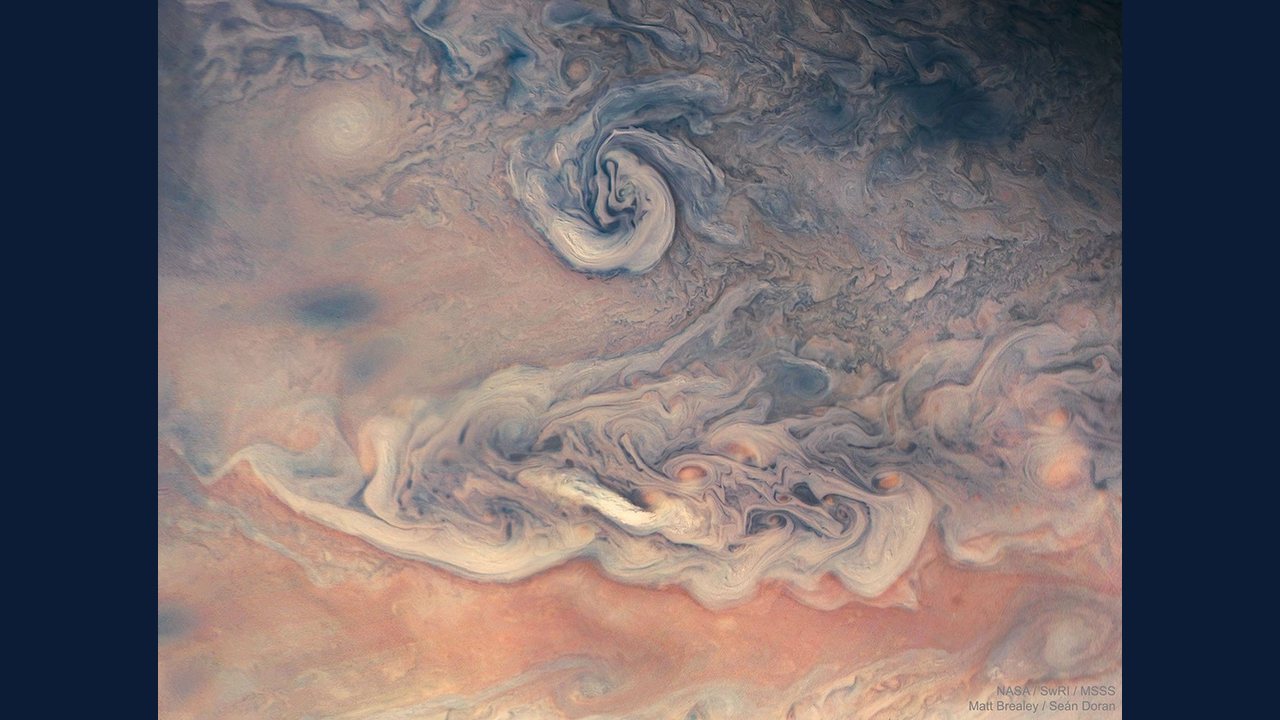
NASA’s Astronomy Picture of the Day (APOD) for 22 Nov 2026 showcases a color‑enhanced photograph taken by the Juno spacecraft during its 14th close flyby of Jupiter in 2018. The image displays light clouds swirling around reddish zones and overlaying darker regions, prompting scientists to discuss possible chemical contributors to the planet’s vivid colors.
What the Image Shows
- Light‑colored clouds appear higher in the atmosphere, wrapping around reddish patches on the lower‑right side of the frame.
- Darker cloud decks dominate the upper‑right quadrant, partially obscured by the lighter material.
- The photograph was captured on a low‑altitude pass, roughly 4,200 km above the cloud tops, during Juno’s 33‑day elliptical orbit.
Scientific Context
- Confirmed: Jupiter’s bulk atmosphere is composed mainly of hydrogen and helium, which are essentially colorless at the frigid temperatures of the upper cloud layers.
- Reported hypothesis: Trace amounts of ammonium hydrosulfide (NH₄SH) are a leading candidate for producing the observed yellows and reds, though the exact mix of chromophores remains under investigation.
- Unknown: No definitive measurement has yet identified the precise concentrations of NH₄SH or other possible pigments such as phosphine or complex organics.
Practical Implications
- Understanding the cloud chemistry helps refine models of atmospheric dynamics, which in turn improves predictions of storm formation and heat transport on gas giants.
- Researchers can compare this 2018 snapshot with newer Juno observations (each orbit provides a slightly different viewing sector) to track temporal changes in cloud composition.
How to Verify
- The original APOD entry is hosted on NASA’s Science website: https://science.nasa.gov/image-article/apod-2026-november-22-swirls-and-colors-on-jupiter-from-juno/
- Juno’s mission data, including raw imaging files, are archived at the Planetary Data System (PDS) and can be cross‑checked against the enhanced version shown on APOD.
Next Image
APOD notes that the following day’s picture will feature “emerging darkness,” indicating a shift to a different region of Jupiter’s atmosphere.
--- *All information is drawn from the APOD description and publicly available Juno mission data; no speculative quotes or unpublished figures are included.*
Share this article
Read the original source APOD: 2026 November 22 – Swirls and Colors on Jupiter from Juno