NASA's Lucy Spacecraft Enters Unexplored Jupiter Trojan Asteroid Region
· GlobeWire Daily Science Desk · Source: science.nasa.gov
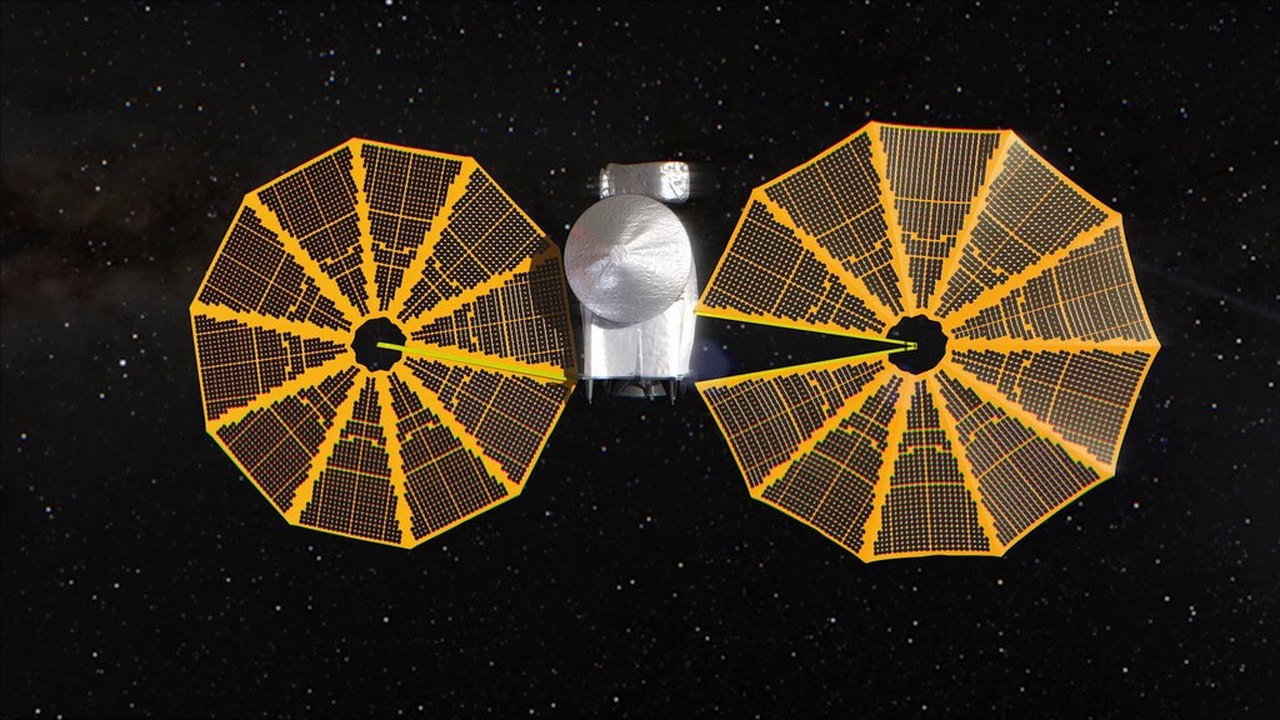
Image: science.nasa.gov — Creative Commons
Reaching the Trojan Asteroids After Five Years
NASA’s Lucy spacecraft has officially entered the region of the Jupiter Trojan asteroids, marking a major milestone five years after its launch on October 16, 2021. Having traveled more than 2.2 billion miles, Lucy is the first mission designed to explore this distant population of primitive solar-system bodies.
Mission engineers confirmed the milestone by tracking the spacecraft's radio signals and analyzing images of surrounding stars. Lucy is currently approaching Jupiter’s Lagrange point 4 (L4), one of two large gravitational "islands of stability" where thousands of asteroids share Jupiter's orbit around the Sun.
Understanding the Mission Path and Timeline
The L4 region contains a cluster of asteroids traveling ahead of Jupiter, while a second group near Lagrange point 5 trails behind the gas giant. These clusters reside roughly 484 million miles from the Sun. Because the individual asteroids are separated by an average of more than 6 million miles, they currently appear to the spacecraft as small points of light against background stars.
Lucy’s first close-up encounter with a Trojan asteroid is scheduled for August 11, 2027, when it flies past Eurybates. Following that initial encounter, the mission schedule includes flybys of Polymele in September 2027, Leucus in April 2028, and Orus in November 2028. The spacecraft will then swing back toward Earth in 2030 for a gravity assist, propelling it toward Jupiter's trailing swarm to study the binary asteroid pair Patroclus and Menoetius in March 2033.
Scientific Objectives and Spacecraft Status
Scientists hope that examining the Trojans up close will provide critical data to refine theories regarding how the planets formed approximately 4.5 billion years ago and reached their current positions.
As the spacecraft cruises deeper into space, it continues to adapt to increasingly dim light and cooling temperatures. Because Lucy is engineered specifically for operations more than five times farther from the Sun than Earth, its instruments and systems are continuing to function as expected. With less than a year remaining before the Eurybates encounter, mission teams are finalizing preparations to maximize data collection during the brief hours of close study.
Practical Implications and Verification
For space science enthusiasts and researchers, the entry of Lucy into the Trojan region represents a foundational step toward understanding early solar system evolution. Unlike previous spacecraft that used Jupiter primarily for gravity assists to travel elsewhere, Lucy is dedicated entirely to exploring these distant remnants.
Readers can review confirmed mission milestones, background details, and trajectory visualizations directly through the official NASA update at the [NASA Science Blogs](https://science.nasa.gov/blogs/lucy/2026/10/28/nasas-lucy-reaches-trojan-asteroid-region-5-years-after-launch/).
AI-assisted reporting; source claims are attributed and have not been independently verified.
More to read
 China’s Chang’e-7 Mission Prepares to Hunt for Lunar Ice at the Moon's South Pole
 ISRO Employee Associations Seek Official Clarification Amid Space Sector Privatisation Push
 US Economists Robert Hall and Michael Woodford Win 2026 Nobel Economics Prize
 ISRO Prepares GSLV-F17 Rocket to Launch EOS-05 Earth Observation Satellite
Trending on GlobeWire Daily
Selected from recent coverage and related topics; not live search rankings.
 Four Years After Historic UN Biodiversity Deal, Global Targets Face Severe Implementation Gaps
 Bihar Museum Ranks Ninth Globally, Sparking Praise From Anand Mahindra and an Official Invitation From State Leadership
 Latin’s Enduring Benefits: Teachers Report Lifelong Skills From Classical StudiesISRO Employee Associations Seek Official Clarification Amid Space Sector Privatisation Push
 State Bank of India Fixed Deposit Interest Rates: Overview of Tenures and Returns for General and Senior Citizens
 Qualcomm Opens Application Process for Associate Software Engineer Role in Bengaluru