Interstellar Comet 3I/ATLAS Found Hiding in Pre-Discovery Images from Vera C. Rubin Observatory
· GlobeWire Daily Editorial Desk · Source: www.space.com
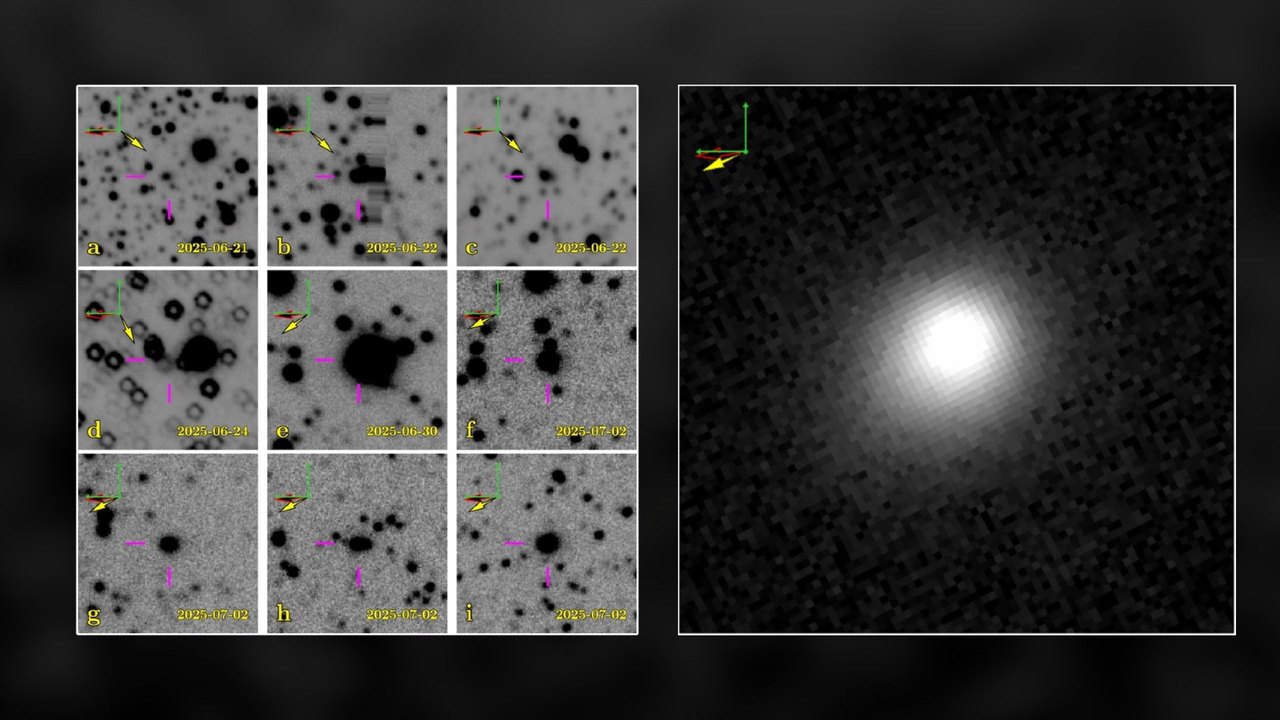
Image: Space · Photo source · Resized and letterboxed to 16:9; no AI generation
Astronomers have discovered that the interstellar comet 3I/ATLAS was captured by the Vera C. Rubin Observatory in Chile over a week before its official detection, according to a study published on April 20 in *The Astrophysical Journal Letters*. While the comet was officially identified on July 1, 2025, by the Asteroid Terrestrial-impact Last Alert System (ATLAS), researchers recently found that Rubin had coincidentally imaged the visitor from the stars during its very first night of practice images on June 20, 2025, while the telescope was in its science validation phase.
Pre-Discovery Findings and Custom Data Processing
A team led by Colin Orion Chandler of the University of Washington searched through commissioning data from the Rubin Observatory to determine if the telescope had previously observed 3I/ATLAS. Because Rubin's standard data-handling pipelines were not yet operational during the validation phase, the research team developed a custom pipeline to access and process the data.
Key details from the analysis include:
- Early Detection: Rubin imaged 3I/ATLAS on June 20, ten days prior to the official ATLAS discovery.
- Repeated Sightings: The observatory captured the interstellar comet nine more times between June 21 and July 2, and several additional times through July 20.
- Cometary Activity: The pre-discovery images clearly show an active coma, indicating a cloud of dust and gas surrounding the comet before official detection.
- Future Potential: Researchers estimate that Rubin could discover roughly one interstellar comet per year during its upcoming Legacy Survey of Space and Time.
Spacecraft Observations and Chemical Composition
Additional insights into 3I/ATLAS came from coordinated observations by deep-space missions. In late 2025, as the comet reached perihelion and passed behind the sun from Earth's perspective, instruments on the European Space Agency's JUICE mission and NASA's Europa Clipper—both en route to Jupiter—conducted joint observations.
- Dual Perspectives: JUICE observed the comet's dayside while Europa Clipper viewed its nightside.
- Gas Emissions: Ultraviolet Spectrograph (UVS) instruments detected hydrogen, oxygen, and carbon resulting from ultraviolet sunlight breaking apart escaping molecular gases.
- Carbon Abundance: The detected carbon levels exceeded typical levels found in solar system comets, supporting earlier observations by the James Webb Space Telescope regarding excess carbon dioxide.
Practical Implications and Verification
These findings expand scientific understanding of interstellar bodies, suggesting that analyzing water-ice and dry-ice ratios helps researchers compare the composition of alien star systems to our own. With a nucleus measuring approximately one kilometer (0.6 miles) wide and a high velocity of 140,000 mph (61 kilometers per second), the comet is estimated to be between 7 billion and 12 billion years old.
Readers can verify these findings by reviewing the published study in *The Astrophysical Journal Letters* or consulting public updates from NASA, the European Space Agency, and the Vera C. Rubin Observatory.
AI-assisted reporting; source claims are attributed and have not been independently verified.
More to read
 ASUS Ramps Up NVIDIA Vera Rubin NVL72 Shipments in Q4 Amid Strong Demand, Showcasing AI Factory Reference Architecture at SC26
 New Vera C. Rubin Telescope Spots Icy Candidate Beyond Pluto That Could Become a Dwarf Planet
 Voyager 1 Reaches One Light‑Day From Earth, Marking a New Interstellar Milestone
 New Cryptography-Inspired Method Accelerates Pulsar Discovery in NASA Data