GitHub Launches Public Preview of Code Scanning for AI and Agent Vulnerabilities
· GlobeWire Daily Tech Desk · Source: github.blog
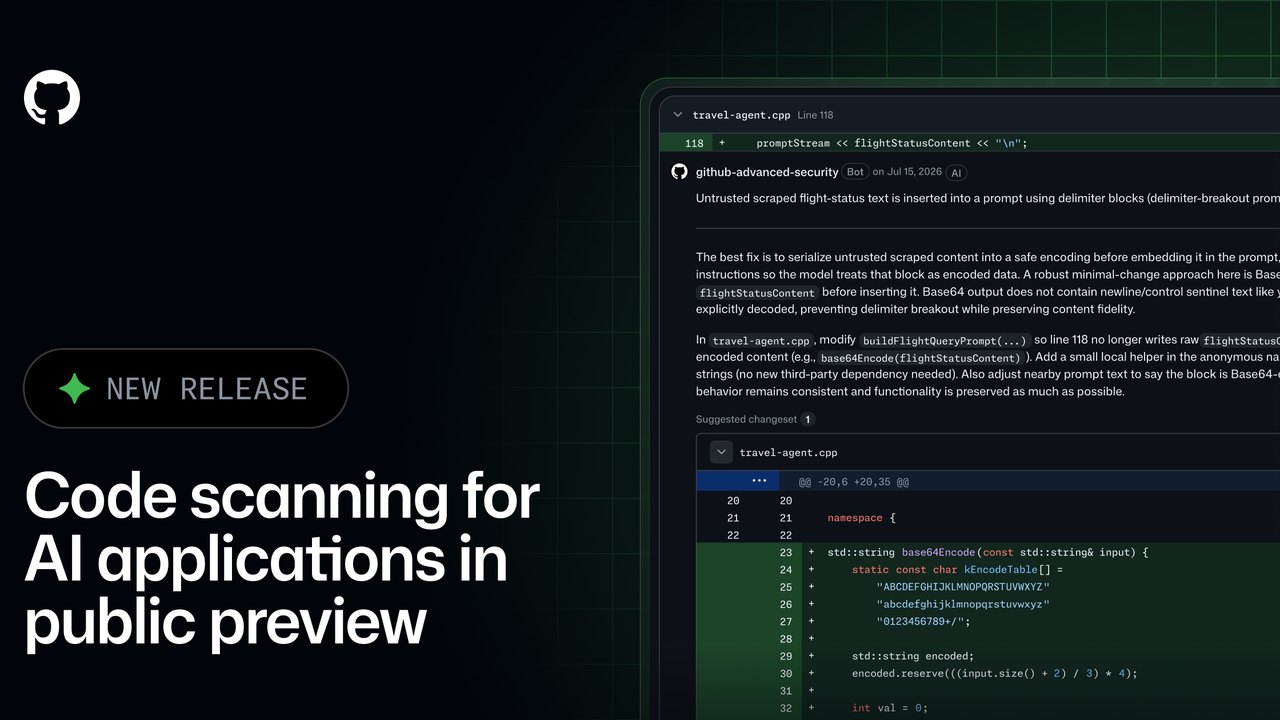
Image: github.blog — Creative Commons
Expanded Security Coverage for AI Codebases
GitHub has announced the public preview of code scanning capabilities specifically designed to detect vulnerabilities in artificial intelligence applications and autonomous agents. The updated scanning system automatically analyzes pull requests alongside existing CodeQL analysis, aiming to help development teams identify complex AI-specific security risks before code is merged into production.
The newly introduced feature addresses several prominent threat categories associated with modern AI architecture, including indirect prompt injection, sensitive information disclosure, and excessive agency. According to the announcement, these automated checks run natively within standard repository workflows to flag insecure code paths where untrusted inputs might reach models equipped with broader system access.
Key Vulnerabilities Targeted
The scanning tool covers multiple specific risk areas identified in contemporary AI security frameworks:
- Indirect Prompt Injection (XPIA): Recognized as a leading risk for large language model applications, XPIA occurs when malicious instructions are concealed within untrusted content—such as external files, web pages, or issue comments—that an AI agent subsequently processes. If the affected agent maintains access to tools or business systems, hidden instructions may manipulate its operational behavior.
- Sensitive Information Disclosure: This risk arises when AI applications or agents access confidential data without sufficient authorization controls, potentially exposing restricted information to unauthorized users or connected systems.
- Excessive Agency: This category involves scenarios where an AI agent possesses greater autonomy, permissions, or capabilities than required for its designated tasks, elevating the potential for high-impact or unintended actions.
Practical Implications and Availability
For development teams building systems with integrated AI components, the automated pull request checks provide inline mitigation guidance directly within the interface. Alerts appear on the Conversation or Files changed tabs, allowing maintainers to address identified issues prior to deployment.
Organizations utilizing the feature must meet specific criteria. The public preview is currently available on github.com and requires a GitHub Advanced Security license. It is not supported on GitHub Enterprise Server during the initial preview phase.
Verified Facts vs. Unknowns
- Confirmed: The code scanning feature for AI applications is currently in public preview on github.com, requires a GitHub Advanced Security license, runs automatically on pull requests, and targets vulnerabilities like indirect prompt injection, sensitive information disclosure, and excessive agency.
- Unknown: Specific timelines for general availability, future expansion to GitHub Enterprise Server, and performance metrics across different programming languages were not detailed in the announcement.
Readers can verify the official announcement and review technical guidelines directly at the [GitHub Blog](https://github.blog/changelog/2026-10-28-code-scanning-for-ai-applications-in-public-preview/).
AI-assisted reporting; source claims are attributed and have not been independently verified.
More to read
 GoDaddy Introduces Airo AI Builder to Streamline Website and App Creation
 Drupal Issues Urgent Patch for Critical Commerce Core Flaw Actively Exploited in Attacks
 Sony Announces Film Adaptation of Indie Horror Game 'Mouthwashing'
 Inside 'Manhood': New Documentary Explores the Booming Business of Male Insecurity and Penile Enhancement
Trending on GlobeWire Daily
Selected from recent coverage and related topics; not live search rankings.
 India Projected to Need Up to 1.5 Billion Sq Ft of Private Education Space by 2035, Says CBRE Report
 Coal India Posts 57% Profit Surge in Q2 on Higher Offtake and Improved Pricing
 IIT Kharagpur to Establish India's First Physical AI School Focusing on Robotics and Computational Engineering
 Prestige International Pictures Boards SXSW Mexican Teen Body Horror 'Fifteen' Ahead of AFM
 India Post Announces 24 Staff Car Driver Vacancies in Tamil Nadu Circle for 2026
 GRID India Opens Applications for 15 Paid Power‑System Internships (Oct‑Nov 2026)