New Claude Code Skill Turns Ambiguous AI Output into Simplified Technical English
· GlobeWire Daily Editorial Desk · Source: github.com
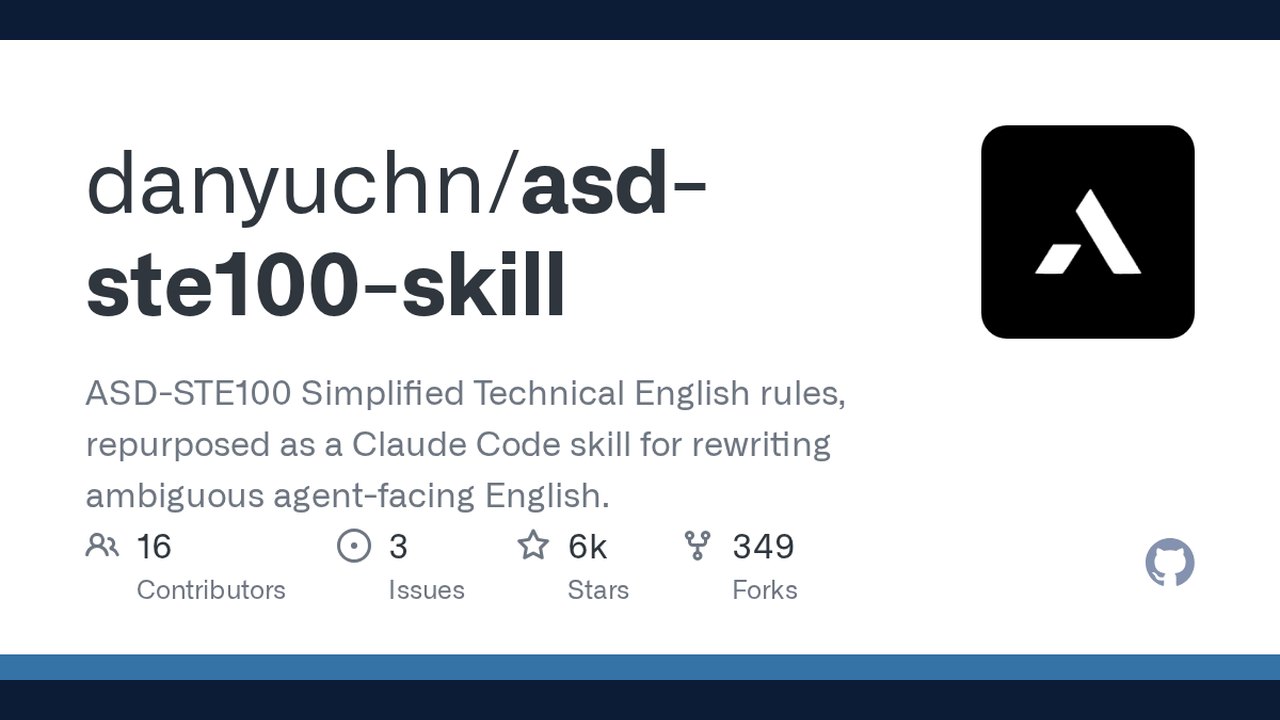
Image: GitHub · Photo source · Resized and letterboxed to 16:9; no AI generation
What the skill does
A new Claude Code skill hosted on GitHub rewrites dense, ambiguous English into ASD‑STE100 Simplified Technical English (STE). STE is the controlled‑language standard created for the aerospace and defence sectors to make maintenance instructions unambiguous for non‑native speakers. The skill applies the same discipline to machine‑generated text – tool descriptions, error messages, or inter‑agent instructions – where no human is available to ask for clarification.
Why it matters
- Safety‑critical precedent: In aircraft maintenance a misread instruction can be fatal. STE eliminates that risk by enforcing one meaning per word, active voice, short sentences, and a single instruction per sentence.
- Agent‑to‑agent parity: An AI agent parsing another agent’s output faces a similar problem – there is no back‑channel to resolve ambiguity. By forcing STE‑style constraints, the skill reduces the chance that downstream agents misinterpret a command or description.
Core features (as documented in the repo)
- Two operating modes
- Strict – targets procedures, error messages, and tool specifications.
- STE‑flavored – works on READMEs, pull‑request descriptions, and explanatory prose, keeping sentence discipline without the full vocabulary lock‑down.
- Rule‑by‑rule linting – the skill scans each sentence for violations such as:
- ambiguous word choice
- present‑perfect or complex tenses
- passive voice with unclear actor
- multi‑instruction sentences
- oversized noun clusters, dropped words, overly long sentences
- phrasal verbs, nominalisations, semicolons, marketing adjectives, and hedge stacks
- Automatic rewrite – flagged sentences are rewritten while preserving every fact, condition, and scope qualifier. If a shorter phrasing would lose required precision, the longer version is kept and a “Kept as‑is” note is added.
- Explainability – users can request a diff or a table that lists which rules were broken and how they were fixed.
- Installation – the fastest method is the `skills` CLI (`skills install danyuchn/asd-ste100-skill`). An alternative is cloning the repo into `~/.claude/skills/`.
- Telemetry – the CLI sends anonymous install telemetry (skill name and timestamp). Setting `DISABLE_TELEMETRY=1` disables it.
Limitations noted by the developers
- The linter checks structural patterns only; it does not verify that the rewritten text retains the same requirement strength or meaning.
- The built‑in dictionary is not the official ASD‑STE100 word list (which is copyrighted and only redistributable with permission). The skill relies on the principle of “plainest available word used consistently”.
- Certain markdown constructs (e.g., nested lists, HTML blocks) are only partially understood, which can lead to false‑negative or false‑positive lint results.
- The skill is not intended for creative writing, marketing copy, or any content where tone and nuance are essential.
How to verify the output
- Run the linter on the original text (`python scripts/ste‑lint.py <file>`). Note the violations reported.
- Ask Claude to apply the skill and request a “show the diff”. Compare the before/after table to ensure no factual loss.
- Cross‑check critical instructions against the official ASD‑STE100 guide (available from the Aerospace and Defence Industries Association of Europe) if certification is required.
Ecosystem extensions
- Hebrew port – `g4lb/asd-ste100-hebrew-skill` adapts the same rules for Hebrew, though it is not an official STE standard.
- Indonesian port – `jshsinaga/asd-ste100-indonesian-skill` provides similar functionality for Indonesian technical text.
- Fidelity comparison – `meiluosi/rewrite-fidelity-skill` can compare original and rewritten texts to flag potential meaning changes, but its flags must be reviewed manually.
Practical implications for developers
- Cleaner prompts: When building multi‑agent workflows, feeding STE‑compliant messages can reduce misinterpretation bugs.
- Documentation hygiene: Project READMEs and API docs can be automatically tightened, making them easier for non‑native engineers to understand.
- Compliance check: For aerospace or defence contractors, this skill is not a substitute for a certified STE audit, but it can serve as a first‑pass sanity check.
What’s next?
The repository’s README invites contributors to improve rule coverage (e.g., expanding the phrasal‑verb list) and to add more robust markdown parsing. No official roadmap is published, so future enhancements remain speculative.
--- *The article is based on the public GitHub repository `danyuchn/asd-ste100-skill` (accessed 4 Nov 2026). All claims are either directly stated in the repo or derived from its documentation.*
AI-assisted reporting; source claims are attributed and have not been independently verified.
More to read
 Claude Opus 5.5 Skill Turns Code Into Short Videos – How “video‑director” Works
 Video Shotcraft Released: AI Video Generation Skill for Claude Code and Codex
 Hallmark Skill Promises AI‑Generated Design Detection for Claude Code, Cursor, Codex
 New Claude Code Skill Brings Professional Mobile App UI Design Principles to Developers
Trending on GlobeWire Daily
Selected from recent coverage and related topics; not live search rankings.
 Harley-Davidson Pan America: Specifications & buying guide
 Ducati Mach 1: Specifications & buying guide
 Zeekr 001: Specifications, variants & buying guide
 Wuling Zhengtu: Specifications, variants & buying guide
 Samsung Galaxy Note 3: Specifications & buying guide
 Huawei Ascend P6: Specifications & buying guide