New Software Enhancement Boosts Webb Telescope’s Ability to Image Exoplanets
· GlobeWire Daily Editorial Desk · Source: arstechnica.com
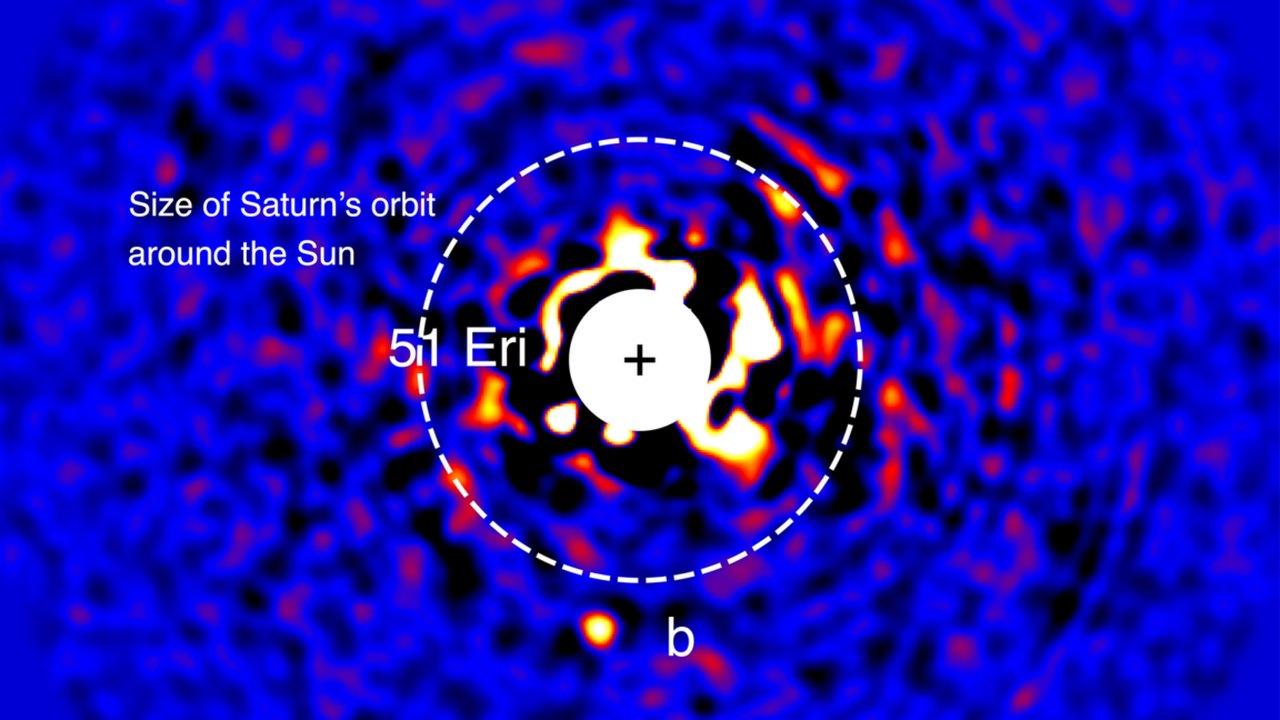
Image: Ars Technica · Photo source · Resized and letterboxed to 16:9; no AI generation
Researchers have introduced a new software technique called FLIP (Physics-based Learning for Imaging Planets) designed to improve the clarity of exoplanet images captured by the James Webb Space Telescope. By optimizing the physical model of the telescope's hardware, this approach significantly reduces the noise that typically obscures distant planets from the intense glare of their host stars.
Understanding the Challenge
Directly imaging an exoplanet is difficult because stars are significantly brighter than the planets orbiting them. While tools like coronagraphs are used to block starlight, imperfections in telescope hardware and slight tracking variations create a "point spread function" (PSF)—a mathematical distortion that blurs the image.
The FLIP Approach
Traditional methods for calculating the PSF often struggle with the complexity of modern instruments or the changing nature of telescope hardware over time. The research team utilized a process involving:
- Physical Modeling: Integrating a detailed model of the Webb Telescope’s NIRCam instrument.
- Gradient Descent: Borrowing techniques from artificial intelligence to tune over a million parameters effectively.
- Efficient Processing: Using GPUs to complete the optimization process in approximately 30 minutes.
Results and Implications
In testing, the FLIP method increased the signal-to-noise ratio by factors of 1.5 to 2 for observations of stars HIP 65426 and 51 Eridani. For the star TYC 5899, the approach improved sensitivity by a factor of 15. This advancement may allow astronomers to detect older, dimmer, or lower-mass planets that were previously undetectable.
Researchers suggest that beyond imaging, the software could help diagnose telescope hardware performance. The study, published in Nature (2026), provides a new framework for analyzing existing and future telescope data. Readers can verify these findings by referencing the peer-reviewed publication under DOI: 10.1038/s41586-026-11213-z.
AI-assisted reporting; source claims are attributed and have not been independently verified.
More to read
 NASA’s Webb Telescope Detects New Small Moon Orbiting Uranus
 NASA Releases James Webb Space Telescope's First Full-Color Science Images
 Scientists Identify ‘Astronomy’s Platypus’ with NASA’s Webb Telescope
 NASA's James Webb Space Telescope Reveals Detailed Map of Dark Matter's Influence