Health & Science
Galaxies Collide in the NGC 7771 Group, 200 Million Light‑Years Away
· GlobeWire Daily Editorial Desk
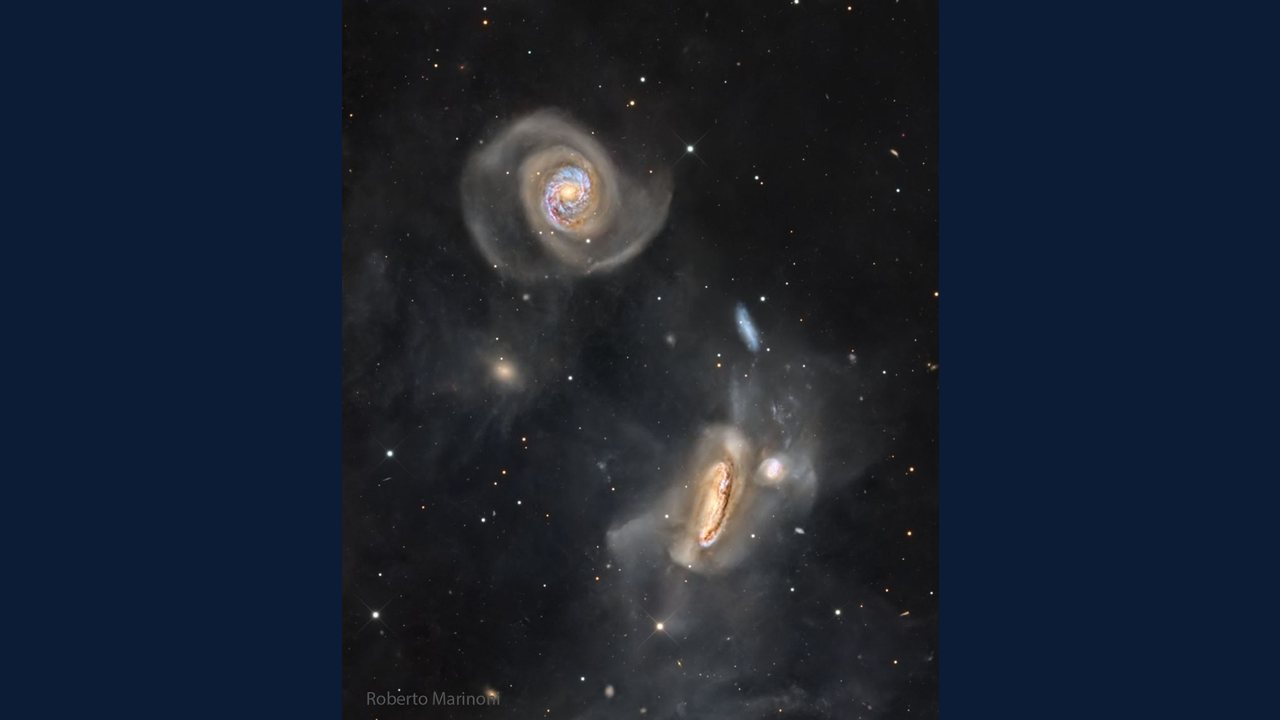
Cosmic Clash in Pegasus
Astronomers using NASA’s APOD archive have highlighted a dramatic interaction among several galaxies in the NGC 7771 Group, located roughly 200 million light‑years toward the Pegasus constellation. The featured image shows the barred spiral NGC 7771 (lower right) and the neighboring spiral NGC 7769 (upper left) surrounded by faint tidal rings and star‑swirl patterns that are the remnants of earlier close encounters.
What is happening?
- Current state: The two large spirals and a handful of smaller companions are on repeated, close passages that generate tidal forces, pulling out streams of gas and stars.
- Future outlook: Over the next few billion years the group is expected to merge into a single, much larger galaxy. This gradual coalescence is a normal phase of galactic evolution.
Why it matters
- Scientific value: Observing such “galaxy battles” provides a nearby laboratory for testing models of how the Milky Way will eventually merge with the Andromeda galaxy.
- Verification: The image and description are posted on NASA’s official APOD page (https://science.nasa.gov/image-article/apod-2026-november-24-galaxies-battle-in-the-ngc-7771-group/) Researchers can cross‑check the coordinates and redshift data in public databases such as NED or SIMBAD.
Practical context
- Next steps for scientists: Follow‑up observations with space‑based telescopes (e.g., Hubble, JWST) and ground‑based spectrographs will map the velocity fields of the tidal streams, refining merger‑time estimates.
- Public interest: The daily APOD feature will continue to showcase related images; tomorrow’s picture will be a generic “open space” view, reminding readers that such events are part of a larger cosmic tapestry.
--- *All statements are drawn from the APOD explanation written by a professional astronomer; no additional speculation has been added.*
Share this article