ESA Releases Euclid's First Detailed Images of the Dark Universe
· GlobeWire Daily Editorial Desk · Source: www.esa.int
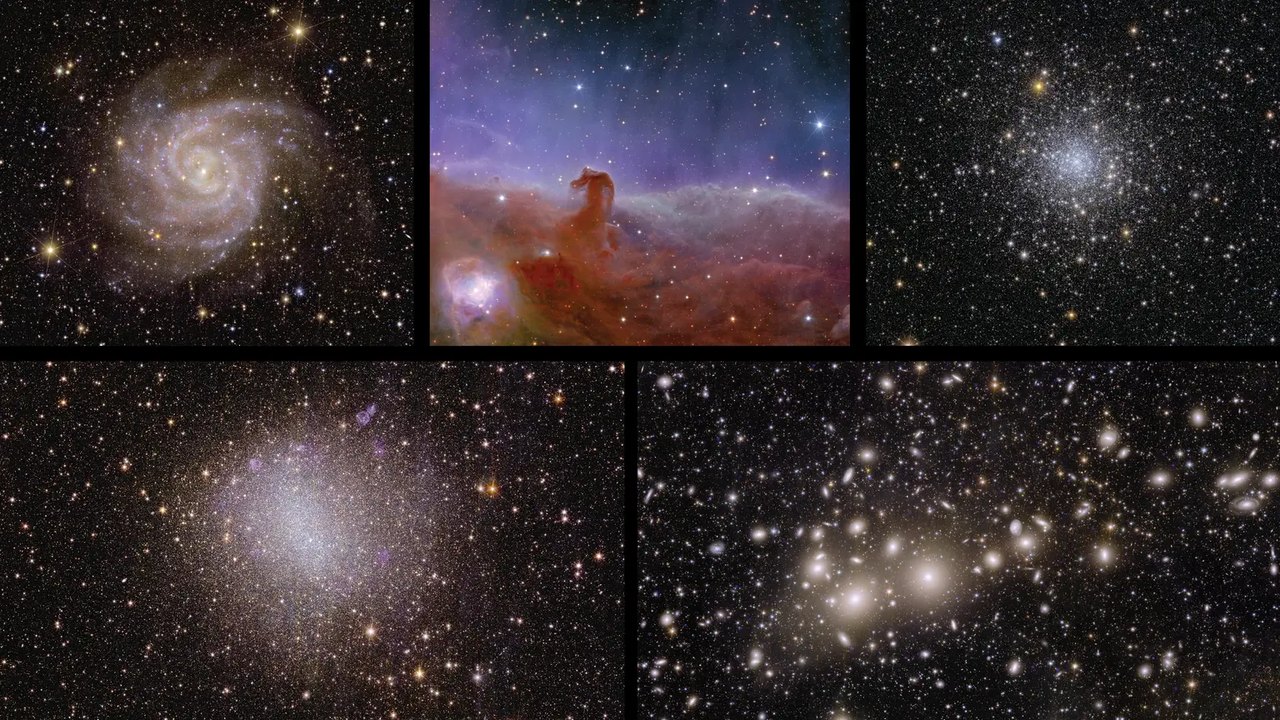
Image: ESA: TBD · Photo source · Resized and letterboxed to 16:9; no AI generation
The European Space Agency (ESA) has released the first full-color images from the Euclid space telescope, designed to investigate dark matter and dark energy, which together make up an estimated 95 percent of the universe. Over a planned six-year mission, Euclid aims to observe billions of galaxies across 10 billion light-years to build a 3D cosmic map.
First Observations and Capabilities
The newly released observations demonstrate the telescope's ability to capture wide yet remarkably sharp visible and infrared images in a single sitting. Highlights from the release include:
- The Perseus Cluster: An image capturing 1,000 galaxies within the Perseus Cluster along with over 100,000 background galaxies, some up to 10 billion light-years away.
- The 'Hidden Galaxy' (IC 342): An infrared look at a Milky Way look-alike to study stellar populations.
- NGC 6822: An irregular dwarf galaxy located 1.6 million light-years from Earth.
- NGC 6397: A globular cluster situated roughly 7,800 light-years away.
- The Horsehead Nebula: A detailed view of Barnard 33 in the Orion constellation, where scientists hope to search for Jupiter-mass planets and baby stars.
Mission Status and Next Steps
Launched on a SpaceX Falcon 9 rocket from Cape Canaveral on July 1, 2023, Euclid is stationed at the Sun-Earth Lagrange point 2. Following a period of instrument testing and calibration, routine science observations are expected to begin in early 2024.
Scientists in the Euclid Consortium will analyze the current data and publish findings in the journal *Astronomy & Astrophysics*. Mission data will eventually be made available to the global scientific community via ESA's Astronomy Science Archives.
Readers can verify official updates and view the original imagery directly on the ESA official website.
AI-assisted reporting; source claims are attributed and have not been independently verified.
More to read
 Euclid Telescope Releases First Massive Data Set, Opening New Window on Dark Matter and Dark Energy
 NASA Releases James Webb Space Telescope's First Full-Color Science Images
 Reported/Unconfirmed: Prime Video Releases First Images for Upcoming 'Boys of Tommen' Series Adaptation
 NASA Releases Red, White, and Blue Cosmic Images to Mark America’s 250th Anniversary