NASA Observes M1-Class Solar Flare Activity in Chromosphere
· GlobeWire Daily Editorial Desk · Source: science.nasa.gov
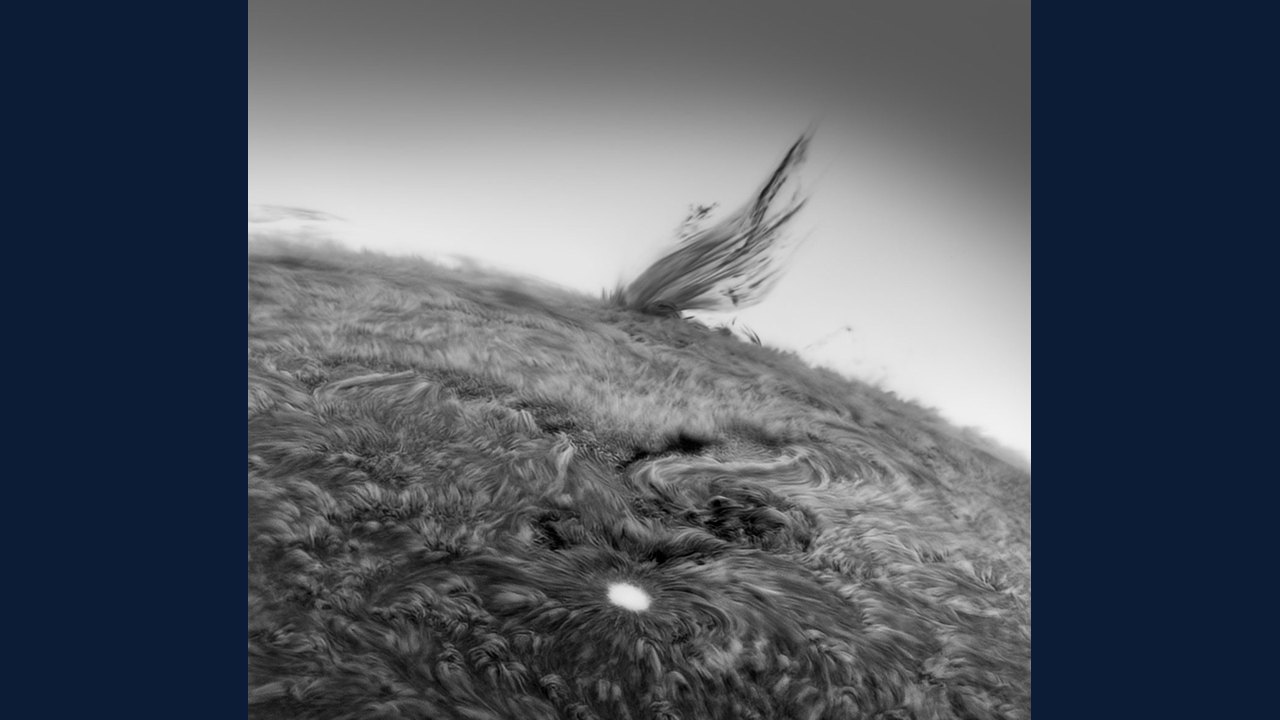
Image: NASA Science · Photo source · Resized and letterboxed to 16:9; no AI generation
Solar Atmospheric Dynamics
Recent observations highlight the complex nature of the Sun's atmosphere. A featured image depicts a solar flare erupting from the chromosphere, the region located above the Sun's visible surface. Scientists observe that temperatures in this layer increase despite its distance from the core, a phenomenon often attributed to energy transferred through magnetic fields.
The Mechanics of a Flare
When magnetic fields within the solar atmosphere twist and reconnect, they release significant bursts of energy. These events manifest as solar flares, characterized by the emission of light and high-energy particles. The specific event featured occurred on May 14, 2025, and was recorded using an H-alpha filter, which specifically detects light emitted by energized hydrogen atoms.
Classification and Impact
Based on data from the GOES (Geostationary Operational Environmental Satellite) observations, this event was categorized as an M1-class flare. Key details regarding this classification include:
- Intensity: M-class flares represent a moderate level of brightness in X-rays.
- Potential Effects: These flares can lead to radio signal blackouts near Earth's polar regions.
- Radiation Risks: Minor radiation storms associated with these events may pose health risks to astronauts working in space.
Monitoring and Safety
While M-class flares are not the most powerful category of solar activity, they remain a focus of study for space weather researchers. Agencies including NASA and NOAA continuously monitor solar activity to improve the ability to predict these events. Such forecasting is essential for the following reasons:
- Protecting satellite communication infrastructure.
- Ensuring the safety of humans currently in space.
- Mitigating disruptions to terrestrial technology.
Individuals interested in solar physics can verify current space weather data and solar monitoring reports by visiting the official NASA and NOAA Space Weather Prediction Center websites.
AI-assisted reporting; source claims are attributed and have not been independently verified.
More to read
 NASA Advances PRIMA Far-Infrared Telescope as First in New Probe Explorers Class
 NASA's NEO Surveyor Mission Reaches Key Milestone With Sunshade and Solar Array Integration
 NASA Selects Innovative Small Business Projects for Moon and Mars Exploration Funding
 NASA's Curiosity Mars Rover Captures Drifting Twilight Clouds