NASA’s SOFIA Discovers Water on Sunlit Surface of Moon
· GlobeWire Daily Editorial Desk · Source: www.nasa.gov
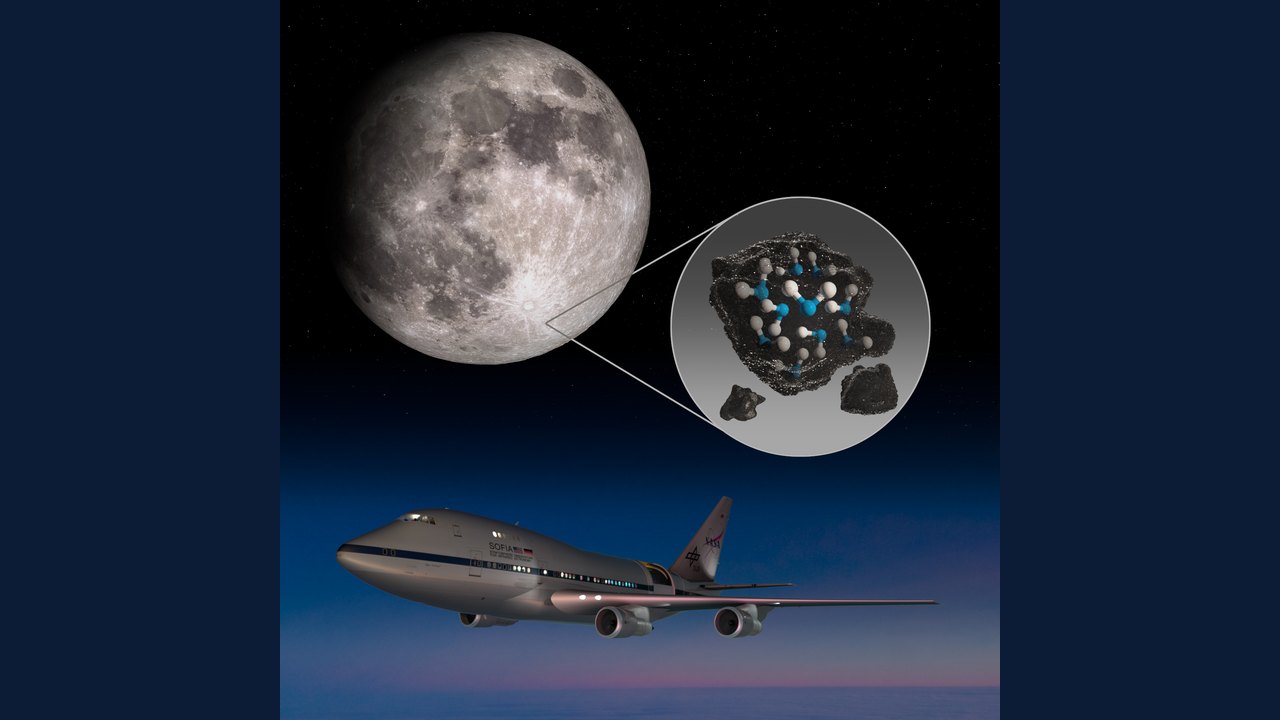
Image: NASA · Photo source · Resized and letterboxed to 16:9; no AI generation
Data from NASA’s Stratospheric Observatory for Infrared Astronomy (SOFIA) have confirmed water molecules on the sunlit surface of the Moon for the first time. The findings indicate that water may be distributed across the lunar surface rather than being restricted solely to cold, permanently shadowed polar craters.
Detection in Clavius Crater
Researchers detected water molecules ($H_2O$) in Clavius Crater, a prominent crater in the Moon's southern hemisphere visible from Earth. Previous lunar observations had identified hydrogen but could not definitively distinguish between water and its chemical relative, hydroxyl ($OH$). The new data reveal water concentrations ranging from 100 to 412 parts per million trapped within a cubic meter of lunar soil.
- Instrument used: Faint Object infraRed CAmera for the SOFIA Telescope (FORCAST)
- Wavelength identified: 6.1 microns
- Publication: *Nature Astronomy*
Origin and Storage Theories
Scientists are currently investigating how the water is created and maintained on the harsh, airless lunar surface despite the lack of a thick atmosphere that would normally cause it to escape into space. Proposed mechanisms include:
- Micrometeorite delivery: Small impacts depositing water or carrying materials that react.
- Solar wind interaction: Hydrogen delivered by solar wind reacting with oxygen-bearing minerals to form hydroxyl, which is subsequently transformed into water by radiation.
Storage could occur either through entrapment in tiny impact-formed glass beads or by hiding between grains of lunar soil sheltered from direct sunlight.
Implications for Future Exploration
Understanding the distribution and accessibility of lunar water is considered vital for deep space exploration and future crewed missions, such as NASA's Artemis program. Future SOFIA flights are planned to observe additional sunlit locations and varying lunar phases to map water resources more comprehensively.
How to Verify
Original announcements, related data, and published papers can be verified through official NASA releases and the *Nature Astronomy* journal.
AI-assisted reporting; source claims are attributed and have not been independently verified.
More to read
 NASA Selects Innovative Small Business Projects for Moon and Mars Exploration Funding
 NASA Conducts RS-25 Engine Test to Support Future Artemis Moon Missions
 NASA's Kepler Mission Discovers Bigger, Older Cousin to Earth
 NASA’s Webb Telescope Detects New Small Moon Orbiting Uranus