Government of Canada Report Projects Continued Warming and Climate Shifts Across Near and Long-Term Scenarios
· GlobeWire Daily Editorial Desk · Source: www.canada.ca
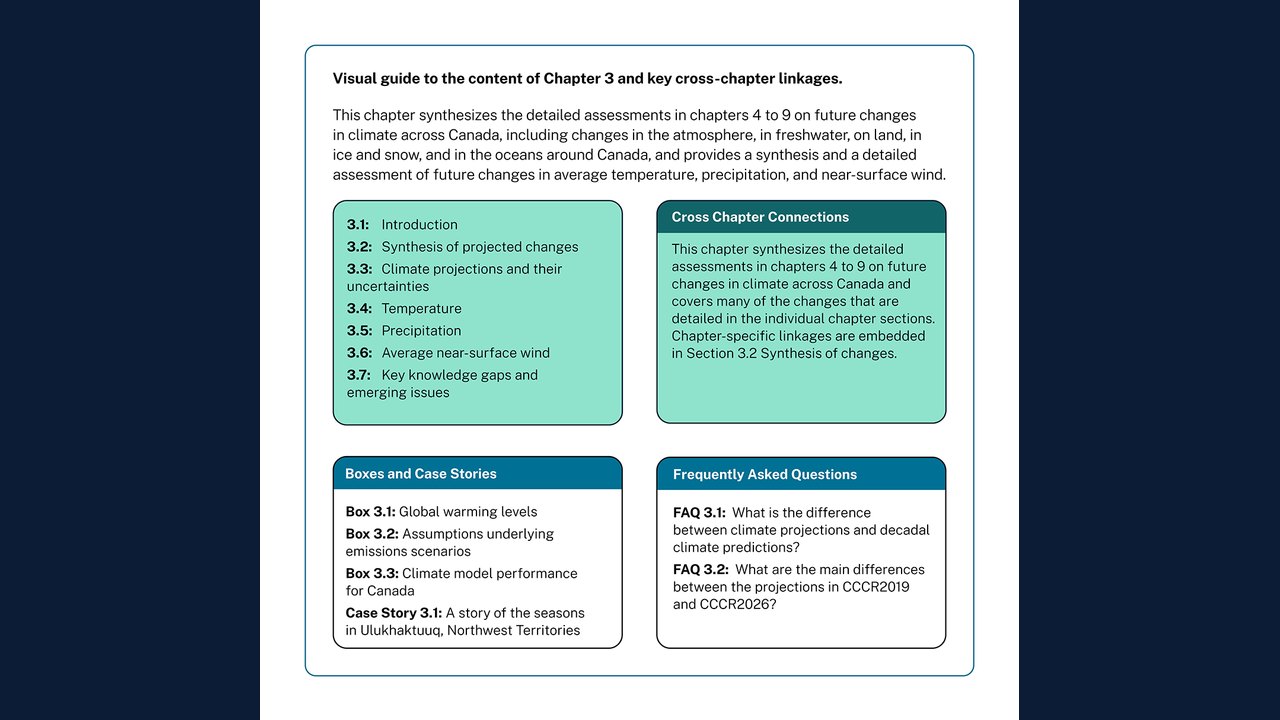
Image: Environment and Climate Change Canada · Photo source · Resized and letterboxed to 16:9; no AI generation
Overview of Canada's Future Climate Projections
Environment and Climate Change Canada and contributing federal departments have released Chapter 3 of Canada's Changing Climate Report, detailing synthesized scientific assessments regarding future climate trends across the country. The report examines projected changes in temperature, precipitation, wind, and cryosphere conditions under varying global greenhouse gas emission pathways.
According to the issuing government authority, the findings highlight distinct trajectories depending on whether global policies result in current trajectories, net-zero achievements, or an absence of climate policies.
Near-Term Projections (2021–2040)
- Continued Warming Rate: Canada is projected to continue warming at approximately twice the global rate across all emissions scenarios.
- Temperature Increase: An average near-term warming of about 0.9°C is projected from 2021 to 2040.
- Precipitation Changes: The country is projected to receive roughly 7% more precipitation on average compared to the 1850–1900 baseline.
- Ongoing Trends: Previously observed patterns—including more frequent hot extremes, earlier peak streamflow, warmer coastal waters, and increased wildfire burn areas—are expected to persist.
Long-Term Climate Scenarios (2081–2100)
The assessment outlines three primary long-term global emissions pathways:
- Current Global Climate Policies: Under this scenario, average warming across Canada is projected to reach 5.0°C by 2081–2100 relative to pre-industrial levels, with precipitation increasing by 13%. Western Canadian glaciers are projected to lose over 75% of their mass.
- Net-Zero Emissions World: If global carbon dioxide emissions reach net-zero in the 2070s, Canadian temperature increases are projected to stabilize in the second half of the century at around 3.5°C above historical averages. However, slow-response elements such as sea-level rise and permafrost thaw will continue.
- No Climate Policies: If emissions continue to rise unchecked, average Canadian temperatures are projected to increase by 6.9°C, accompanied by a 17% increase in precipitation and intensified summer droughts in southern regions.
Official Guidance and Verification
This synthesis serves as a foundational overview for adaptation planning and decision-making across Canadian sectors. Stakeholders and the public are advised to consult the official Environment and Climate Change Canada portal to review the complete assessment, methodology, and regional datasets.
AI-assisted reporting; source claims are attributed and have not been independently verified.
More to read
 London to Close Oxford Street to Traffic as Part of Mayor’s Long‑Term Pedestrianisation Plan
 Warming Faster Than the Planet: How Climate Change is Reshaping the Arctic Village of Longyearbyen
 UK Government Approves Jackdaw North Sea Gasfield, Prompting Broad Climate‑Policy Criticism
 French Student Leaders Urge Continued School Barricades Despite Government Concessions
Trending on GlobeWire Daily
Selected from recent coverage and related topics; not live search rankings.