Study Finds Deaf Children Exposed to Sign Language from Birth Match Hearing Peers in Early Maths
· GlobeWire Daily World Desk · Source: timesofindia.indiatimes.com
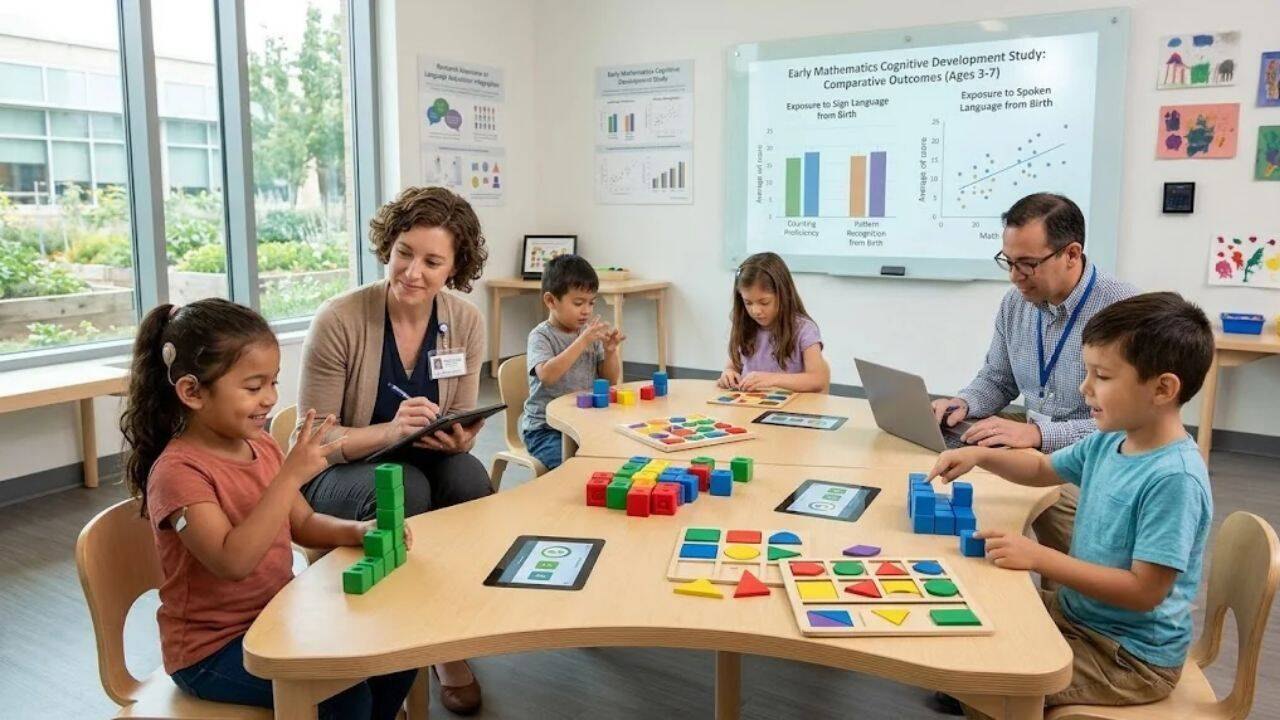
Image: The Times of India · Photo source · Resized and letterboxed to 16:9; no AI generation
A recent study published in the journal *Child Development* reports that deaf children exposed to sign language from birth perform comparably in early maths skills to hearing children who learn spoken language from birth. The research examined 178 children aged approximately three to seven years old and was led by Marie Coppola, a professor of psychological sciences and linguistics at the University of Connecticut.
Understanding the Cardinal Principle
Researchers evaluated children on how far they could count without mistakes and asked them to count objects or create specific quantities. The study focused on whether children understood the "cardinal principle"—the realization that the final number in a count represents the total quantity of the group, rather than just the last item counted.
Key findings include:
- Deaf children with access to American Sign Language (ASL) from birth performed indistinguishably from hearing children with lifelong access to spoken English.
- Children with early access to either spoken or signed language generally performed better on number tasks than those who gained language access later in childhood.
- The observed performance patterns remained consistent even when researchers accounted for socioeconomic status.
Implications for Early Education
Study authors noted that consistent early access to a comprehensible language helps children connect number words or signs with quantities. The findings suggest that deafness itself does not limit a child's mathematical ability; rather, early communication access is critical.
- Researchers advocate for greater awareness of how signed languages support academic development.
- The study encourages families and educators to provide accessible communication channels to help build foundational learning skills from the earliest years.
Readers can verify the original announcement by consulting the journal *Child Development* for the published paper.
AI-assisted reporting; source claims are attributed and have not been independently verified.
More to read
 US Hyperscale Data Centers Match Michigan's Annual Electricity Consumption, Study Finds
 Study Finds Women’s Agricultural Empowerment Strengthens Food Security in South Sudan
 Weight-Loss Drugs Used in Nearly One in 10 Great Britain Homes, Study Finds
 Major £10m Study to Analyze Impacts of UK Children's Social Media Ban