GBrain: Garry Tan’s Open‑Source AI Memory Engine
· GlobeWire Daily Editorial Desk · Source: github.com
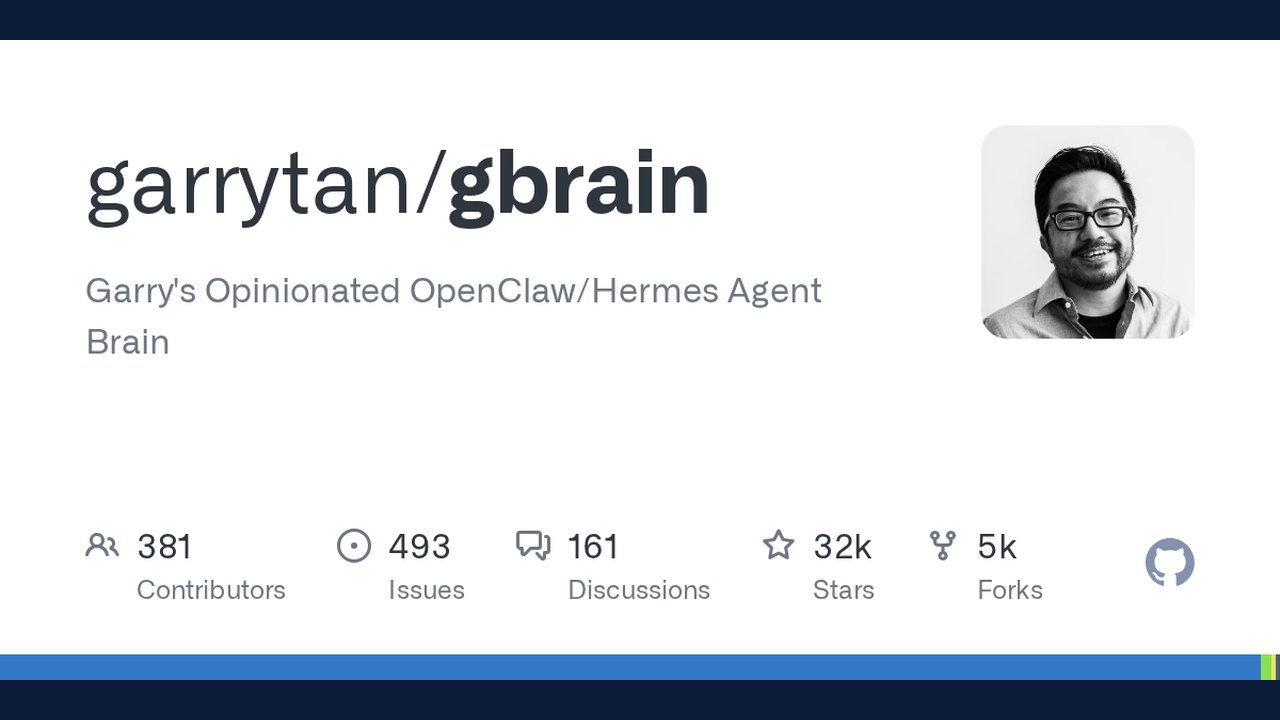
Image: GitHub · Photo source · Resized and letterboxed to 16:9; no AI generation
Overview
GBrain is an MIT‑licensed, self‑hostable memory layer for AI agents, created by Garry Tan, President and CEO of Y Combinator. It stores explicit facts with provenance, supports corrections and withdrawals, and shares the same memory across multiple agents.
Key Features
- Explicit, source‑backed facts – every claim is linked to a source page.
- Correction & withdrawal – facts can be updated or removed.
- Cross‑agent sharing – a single brain can be used by many agents.
- Keyword & semantic retrieval – fast keyword search plus vector‑based semantic search.
- Synthesis layer – generates a concise answer with citations and a gap analysis.
- Typed knowledge graph – supports graph traversal for relationship queries.
- Hosted option – gbrain.io offers a paid, managed hosting service.
- Local deployment – install with Bun (≥ 1.4.4) and run 24/7 for continuous ingestion.
How It Works
- Setup – run `gbrain setup` to configure the brain and connect it to your chosen AI harness (Claude, Codex, ChatGPT, etc.).
- Ingestion – ingest meetings, emails, tweets, voice calls, and other documents. The brain enriches and consolidates data overnight.
- Retrieval – agents query the brain via keyword search (`gbrain search`) or synthesis (`gbrain think`).
- Enrichment – background jobs deduplicate, fix citations, score salience, and detect contradictions.
- Sharing – authorized users can publish skills and share the brain with teams.
Practical Implications
- Personal agents: keep a persistent memory of your interactions and knowledge, improving over time.
- Team brains: create a shared institutional memory that respects source and operation grants.
- Verification: the brain’s gap analysis tells you what it doesn’t know, guiding follow‑up questions.
Getting Started
```bash
Install via Bun
bun install -g github:garrytan/gbrain#stable
Initialize a keyless brain
gbrain setup
Expose over Tailscale for remote use
gbrain mcp expose ```
Verification
- Check the brain’s readiness with `gbrain search --ready`.
- Inspect source pages with `gbrain sources inspect`.
- Use the hosted service at gbrain.io for a zero‑install experience.
Conclusion
GBrain offers a robust, open‑source foundation for building AI agents that remember, reason, and grow. Its explicit memory model and synthesis capabilities make it a powerful tool for both individuals and teams.
AI-assisted reporting; source claims are attributed and have not been independently verified.
More to read
 Garry Tan Releases gstack: An Open-Source Virtual Engineering Team for AI Coding Agents
 Asymptote Labs Releases Beacon: Open-Source Cross-Harness Memory Layer for AI Coding Agents
 Open-Source AI Memory Project Offers Cross-Agent Handoffs and Git-Backed Markdown Storage
 OpenRig Launches as an Open-Source System for Managing Multi-Agent AI Teams
Trending on GlobeWire Daily
Selected from recent coverage and related topics; not live search rankings.
 Madhya Pradesh Government Plans Revenue Generation from 117-Year-Old Edward Villa in Mumbai Through Leasing
 iPhone 18 Pro Named TechRadar Product of the Year 2026
 Google Project Suncatcher Runs Gemma 4 AI on Orbiting Satellite and Receives First Response
 Gender Disparities in Eye Care Access Across India Examined
 Satellite Images Show Cyclone Arnab Weakening Over India As New System Brews
 Expanding Green and Blue Spaces Crucial for India's Economic and Public Health, Reports Indicate