Public Exploit Code Targets Windows CLFS Driver in SignDrop Claims
· GlobeWire Daily Editorial Desk · Source: thehackernews.com
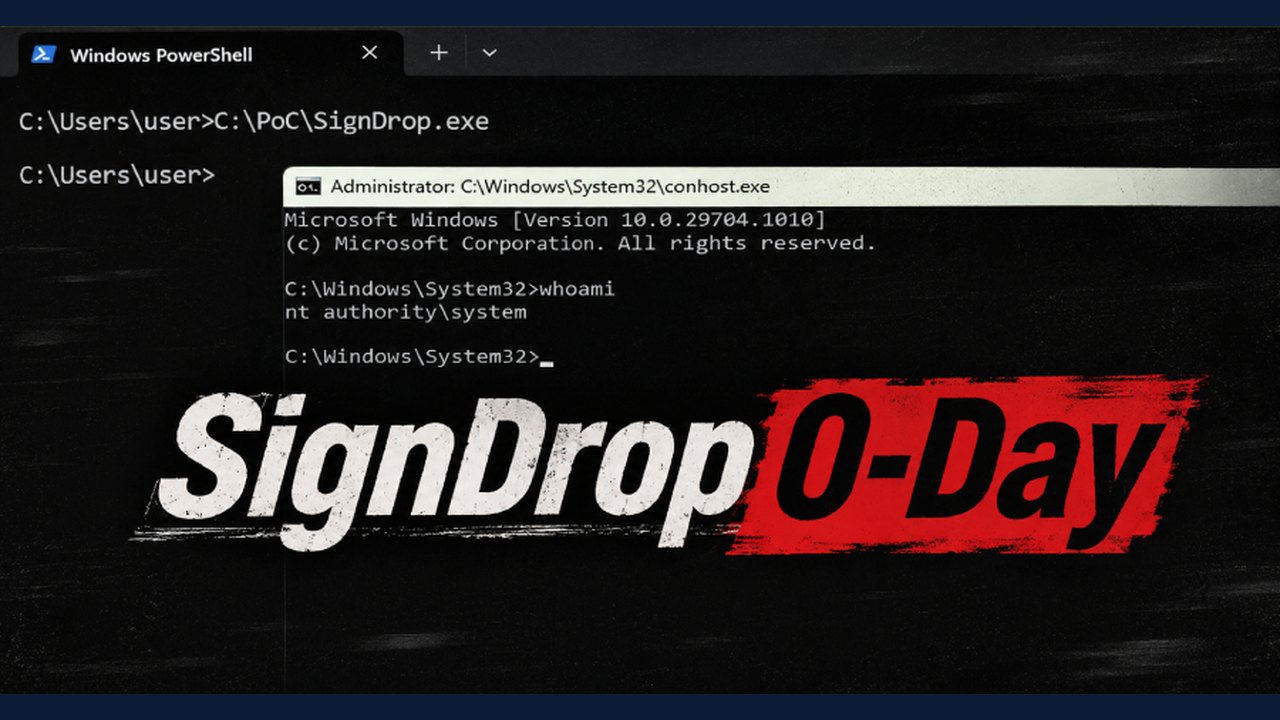
Image: The Hacker News · Photo source · Resized and letterboxed to 16:9; no AI generation
Publicly released exploit code claims that local Windows users can gain SYSTEM privileges through the Common Log File System driver, according to details published on Tuesday. Microsoft has not confirmed the claimed flaw, assigned a CVE, or released a fix. Independent security assessments indicate the technique works under specific conditions, though researchers note reliability limitations.
The proof of concept, designated SignDrop by researcher MSNightmare, targets a log-authentication feature introduced to the driver in late 2025. CLFS is a logging subsystem built into Windows that has historically been a frequent target for privilege escalation vulnerabilities. To mitigate these risks, updates for Windows 11 and Windows Server 2025 added an authentication check using hash-based message authentication codes and companion .cnpf recovery files.
How the SignDrop Proof of Concept Operates
According to the published code and accompanying writeup, the technique relies on path redirection during the creation of the companion .cnpf file:
- A standard user prepares a CLFS log and container utilizing user-controlled paths.
- When a privileged process, specifically the Windows Defender antimalware service in the published chain, opens the log, the driver creates the companion file.
- Object manager symbolic links are reportedly used to redirect file creation to a target location.
- Because the file inherits original log permissions, it is created with SYSTEM privileges while remaining writable by the standard user, which the researcher claims can be chained into a SYSTEM shell.
Tested systems include Windows 11 26H2 and Windows Server 2025 Experimental builds when the CLFS authentication registry mode is set to enforced or learning (values 0 or 1). Disabling the mitigation via registry values 2 or 3 places systems outside the claimed attack surface, but vendor documentation warns this reopens memory corruption risks.
Verification and Independent Assessment
Sungyup Nam of 78researchlab reported that researcher Heewon Song tested the exploit and confirmed it works, while noting it may lack the reliability required for operational use. The exploit requires Defender to be enabled and produces noticeable behavior on the target machine, such as altering User Account Control prompts.
- No CVE, advisory, or official patch has been released.
- CISA has not listed the issue in its Known Exploited Vulnerabilities catalog.
- No active attacks in the wild have been reported.
Administrators can check their exposure by inspecting the CLFS authentication registry key at `HKLM\SYSTEM\CurrentControlSet\Services\CLFS\Authentication`. Monitoring vendor security advisories remains the recommended method for tracking official updates and responses.
AI-assisted reporting; source claims are attributed and have not been independently verified.
More to read
 Critical FortiSIEM Flaw Gets Public Exploit PoC for Unauthenticated Remote Code Execution
 Disgruntled Researcher Discloses Windows Zero-Day SignDrop Enabling System-Level Privilege Escalation
 Babar Azam's Personal Life: Examining Public Speculation, Celebrity Links, and Legal Claims
 GitHub Launches Public Preview of Code Scanning for AI and Agent Vulnerabilities