NASA Data Confirms First-of-Its-Kind Stellar Merger in Andromeda Galaxy
· GlobeWire Daily Editorial Desk · Source: science.nasa.gov
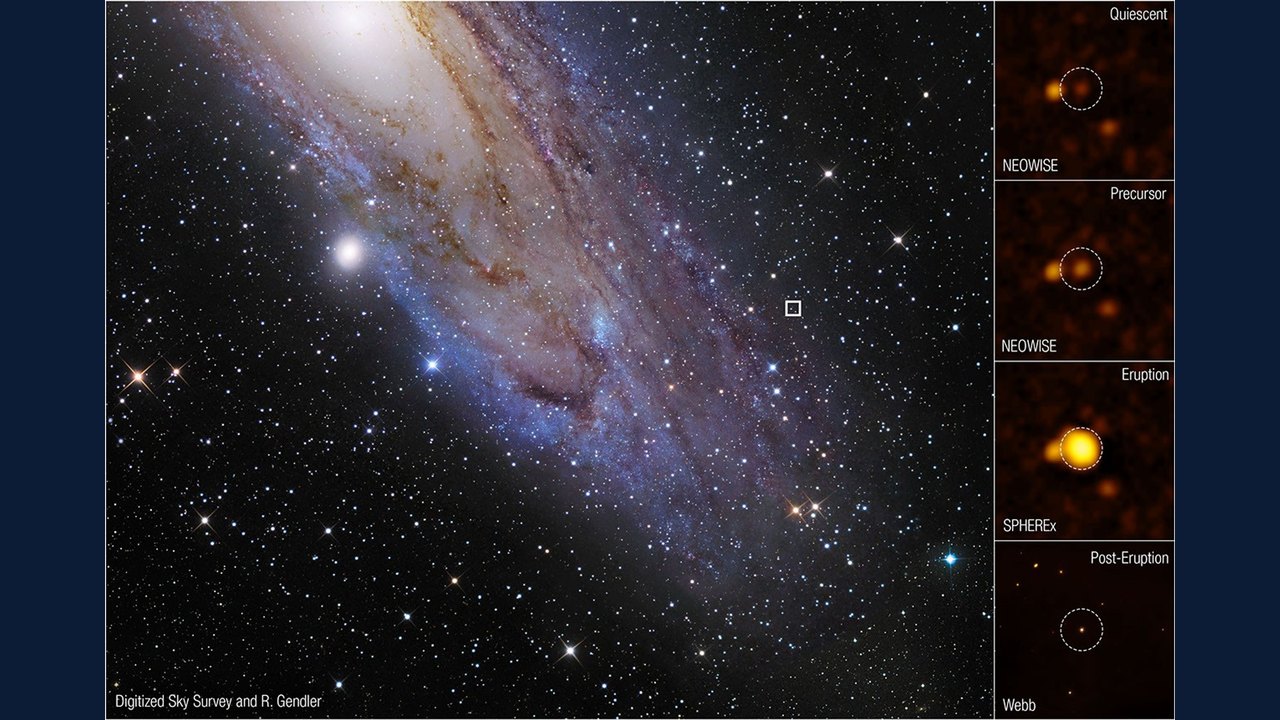
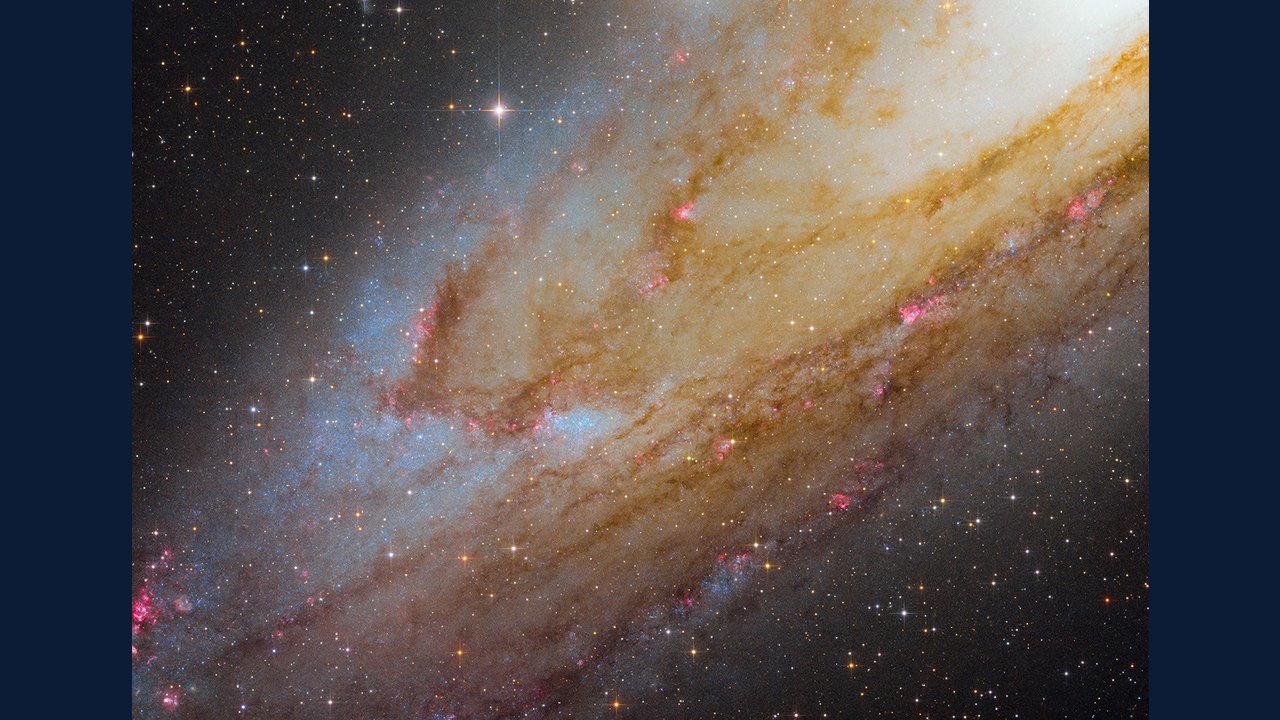
Image: NASA Science · Photo source · Resized and letterboxed to 16:9; no AI generation
Researchers have identified a first-of-its-kind stellar merger in the Andromeda galaxy, where a star slightly less massive than the Sun spiraled into and merged with a puffy supergiant star. The system, nicknamed Bao and formally designated AT 2025abao, was studied using data from NASA's James Webb Space Telescope alongside various space- and ground-based telescopes.
Discovery Timeline and Observations
- Initial Detection: The system first drew attention in February 2023 through data from NASA's retired NEOWISE mission, showing unusual variability.
- Pre-Eruption Activity: Observations in late 2024 and mid-2025 indicated the star was brightening and spewing dust.
- The Eruption: The Zwicky Transient Facility detected the eruption on October 17, 2025.
- Webb Follow-up: NASA's James Webb Space Telescope observed Bao on December 24, 2025, just 47 days after the eruption peaked, marking the earliest follow-up of such an event.
Reconstructing the Merger
The research team utilized ongoing simulations and multi-wavelength observations to reconstruct the event. Prior to the merger, the primary star (Big Bao) was estimated to be seven times as massive as the Sun, with 350 times its radius and 18,000 times its brightness. The companion star (Little Bao) was estimated to be roughly 0.7 solar masses. Unlike typical binary mergers that take thousands of orbits, this unification occurred rapidly over just seven orbits following surface contact.
This process represents a common envelope evolution, where the primary star engulfed the smaller companion. While Webb's data confirmed the merger occurred, researchers note that such systems can alternatively result in surviving binary pairs that eventually form neutron stars, black holes, or produce gravitational waves.
Practical Implications and Verification
The findings offer new insights into common envelope evolution by allowing researchers to analyze the event in real time rather than reverse-engineering past occurrences. Readers can review the original research paper published in *Nature* or check official NASA and ESA announcements for further technical details and updates.
AI-assisted reporting; source claims are attributed and have not been independently verified.
More to read
 New Cryptography-Inspired Method Accelerates Pulsar Discovery in NASA Data
 NASA Confirms Milestone: Exoplanet Discovery Count Hits 6,000
 NASA Releases James Webb Space Telescope's First Full-Color Science Images
 NASA Astronomy Picture Highlights NGC 206 Star Clouds in Andromeda